

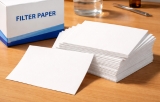
Filterpapier blijft een hoeksteen van laboratoriumfiltratie in de biochemie en moleculaire biologie en biedt kosteneffectieve scheiding van deeltjes, neerslagen en biomoleculen op basis van poriegrootte en doorstroomsnelheid.
Typen en Specificaties
Kwantitatieve filterpapieren (bijv. Whatman Grade 1-6) bestaan uit asvrije (<0,01 %) katoencellulose met gedefinieerde poriediameters (2,5-25 μm), terwijl kwalitatieve kwaliteiten snelheid boven zuiverheid prioriteren voor routinematige filtraties. Ultrafilterpapieren, bereid door standaardvellen te impregneren met 4 % collodium (nitrocellulose in alcohol-ether), worden gehard met formaldehyde om poriën te verkleinen tot 1-10 nm, waardoor scheiding van colloïden uit echte oplossingen mogelijk is via drukondersteunde ultrafiltratie. Medium (10-20 μm), fijne (2-8 μm) en ultrafijne (<2 μm) varianten ondersteunen zwaartekracht-, vacuüm- of Büchner-trechteropstellingen.
Biochemische Toepassingen
In eiwitprecipitatieprocessen vangt Grade 1 (11 μm) TCA/aceton-pellets na lysering op en levert schone supernatanten voor SDS-PAGE. Nucleïnezuurprotocollen gebruiken geharde asvrije papieren voor plasmid-DNA-wassing of RNA-opruiming van polysachariden. Membraangebaseerde varianten (nitrocellulose, 0,45 μm) klaren cellysaten vóór Western blotting of HPLC, terwijl ultrafiltratie in de pulp- en papierindustrie witwater recycleert door colloïden af te stoten (TOC-verwijdering >90 %).
