

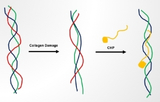
Collagen is the most abundant structural protein in the extracellular matrix (ECM) of mammalian tissues, playing a critical role in maintaining tissue integrity and function. Its unique triple helical structure is essential for mechanical strength and biological activity. However, during physiological remodeling or pathological conditions such as fibrosis, cancer, and tissue injury, collagen molecules often become denatured or fragmented. Detecting and studying these denatured collagen strands is crucial for understanding disease progression and tissue repair mechanisms.
What Are Collagen Hybridizing Peptides?
Collagen Hybridizing Peptides (CHPs) are synthetic peptides designed to mimic the Gly-X-Y repeating sequence characteristic of natural collagen. In their single-stranded form, CHPs can specifically hybridize to unfolded or denatured collagen strands by forming a triple helix, effectively “zipping” onto damaged collagen molecules. This selective binding does not occur with intact, native collagen, making CHPs highly specific probes for collagen damage.
Mechanism of Action
The binding mechanism of CHPs is analogous to DNA hybridization, where single strands anneal to complementary sequences. CHPs exploit the propensity of collagen strands to form triple helices, allowing them to selectively recognize and bind to exposed collagen chains in damaged tissue. This property enables precise localization and quantification of collagen denaturation in various biological samples.
Applications in Research and Medicine
- Imaging and Detection: Fluorescently labeled CHPs enable visualization of collagen damage in histological sections, live tissues, and in vivo models.
- Disease Diagnosis: By targeting denatured collagen, CHPs assist in early detection and monitoring of diseases characterized by ECM remodeling, such as cancer and fibrosis.
- Tissue Engineering: CHPs facilitate integration of biomaterials with host tissues by promoting collagen fibril growth and repair.
- Biochemical Assays: CHPs are used in assays to quantify collagen degradation and remodeling in vitro.
Collagen Hybridizing Peptides represent a powerful and versatile tool for detecting and studying collagen denaturation and remodeling. Their specificity, ease of use, and adaptability make them invaluable in advancing our understanding of tissue biology, disease progression, and regenerative medicine. To support research and clinical studies, we provide a comprehensive range of Collagen Hybridizing Peptide products, including fluorescent and biotin-conjugated variants. These products are optimized for applications such as immunofluorescence, immunohistochemistry, cell imaging, and biochemical assays, enabling researchers to explore collagen biology with high specificity and sensitivity.
