

Ambrisentan [177036-94-1]

Référence T1655-50mg
Conditionnement : 50mg
Marque : TargetMol
Ambrisentan
(Synonyms: LU 208075, BSF-208075, BSF 208075) Copy Product Info

Ambrisentan (BSF 208075) is an endothelin receptor antagonist used in the therapy of pulmonary arterial hypertension (PAH). Ambrisentan has been associated with a low rate of serum enzyme elevations during therapy but has yet to be implicated in cases of clinically apparent acute liver injury.
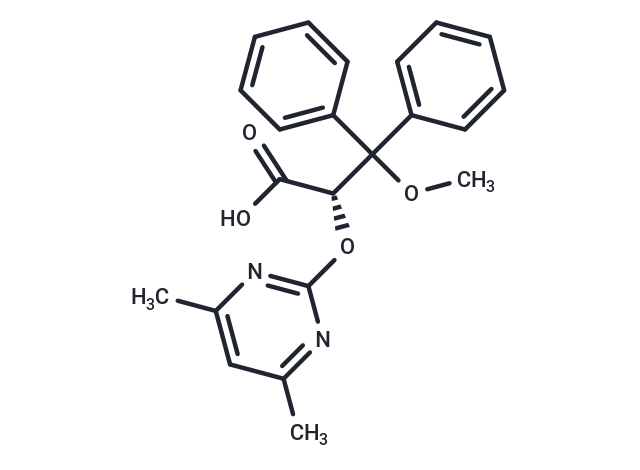
Cas No. 177036-94-1
For research use only—not for human use. No sales to individuals. Use as intended only.
Select Batch
Purity:99.86%
Color:White
COA HNMR LCMS
Product Information
Bioactivity
Chemical Properties
Storage & Solubility Information
| Description | Ambrisentan (BSF 208075) is an endothelin receptor antagonist used in the therapy of pulmonary arterial hypertension (PAH). Ambrisentan has been associated with a low rate of serum enzyme elevations during therapy but has yet to be implicated in cases of clinically apparent acute liver injury. |
| In vivo | In the Ambrisentan group, hepatic hydroxyproline content was significantly reduced (18.0 μg/g±6.1 vs. 33.9 μg/g±13.5 in the control group, P=0.014), indicating a lower level of hepatic fibrosis. Sirius red staining and α-smooth muscle actin positivity were both significantly lower in the Ambrisentan group (0.46%±0.18% vs. 1.11%±0.28%, P=0.0003; and 0.12%±0.08% vs. 0.25%±0.11%, P=0.047, respectively), suggesting reduced activation of hepatic stellate cells. RNA expression levels of procollagen-1 and TIMP-1 in the liver were significantly decreased by 60% and 45%, respectively, in the Ambrisentan group, further demonstrating its effectiveness in attenuating hepatic fibrosis. However, Ambrisentan did not significantly impact inflammation, steatosis, or endothelin-related mRNA expression in the liver. Therefore, Ambrisentan hinders the progression of hepatic fibrosis by suppressing hepatic stellate cell activation and diminishing procollagen-1 and TIMP-1 gene expression, without affecting inflammation or steatosis. |
| Synonyms | LU 208075, BSF-208075, BSF 208075 |
| Kinase Assay | In vitro PTPase assays: Individual PTPases (0.01 μg/reaction) in 50 μL of PTPase buffer [50 mM Tris (pH 7.4)] are incubated at 22 ℃ for 10 min or as indicated in the absence or presence of inhibitory compounds. Substrates (0.2 mM phosphotyrosine peptide) are then added and allows to react at 22 ℃ for 18 hr. PTPase activity of individual reactions is measured by adding 100 μL of malachite green solution (UBI) and then quantifying the amounts of free phosphate cleaved by the PTPase from the peptide substrate by spectrometry (A660 nm). Relative PTPase activities are calculated based on the formula [(PTPase activity in the presence of an inhibitory compound)/(PTPase activity in the absence of the compound) × 100%]. Reactions performed under comparable conditions in the absence of recombinant PTPases only are used as controls and shows no detectable PTPase activity. |
| Cell Research | Ambrisentan is dissolved in DMSO and stored, and then diluted with appropriate medium before use. Unless otherwise stated, for each BMEC experiment cells are randomly divided into 4 groups: (1) normoxia vehicle control (Nx-CTRL); (2) normoxia-treated; (3) hypoxia (24 h) control (Hx-CTRL) and (4) hypoxia (24 h) treated. As previously described, Nrf2 activators are added 24 h prior to any hypoxic exposures. Cell treatments are; Protandim (100 μg/mL), methazolamide (125 μg/mL, nifedipine (7 μg/mL) or Ambrisentan (40 μg/mL). In addition, some cells are treated with Nrf2 siRNA. In these experiments, siRNA is added 24 h prior to drug treatments. The rationale for 24 h hypoxia exposure for BMEC is to ensure that cells remained transfected with siRNA for the pre-treatment of drugs (24 h in normoxia) and during the 24 h hypoxia exposure. Data is collected from at least three separate cell culture preparations on three separate days (n=9)[2]. |
| Molecular Weight | 378.42 |
| Formula | C22H22N2O4 |
| Cas No. | 177036-94-1 |
| Smiles | C([C@H](OC=1N=C(C)C=C(C)N1)C(O)=O)(OC)(C2=CC=CC=C2)C3=CC=CC=C3 |
| Relative Density. | 1.228g/cm3 |
| Storage | Pure form: -20°C for 3 years | In solvent: -80°C for 1 year Shipping with blue ice/Shipping at ambient temperature. | ||||||||||||||||||||||||||||||||||||||||
| Solubility Information | Ethanol: 6 mg/mL (15.86 mM), Sonication is recommended. DMSO: 45 mg/mL (118.92 mM), Sonication is recommended.  | ||||||||||||||||||||||||||||||||||||||||
| In Vivo Formulation | 10% DMSO+40% PEG300+5% Tween 80+45% Saline: 2 mg/mL (5.29 mM), Sonication is recommended. Please add the solvents sequentially, clarifying the solution as much as possible before adding the next one. Dissolve by heating and/or sonication if necessary. Working solution is recommended to be prepared and used immediately. The formulation provided above is for reference purposes only. In vivo formulations may vary and should be modified based on specific experimental conditions. | ||||||||||||||||||||||||||||||||||||||||
Solution Preparation Table | |||||||||||||||||||||||||||||||||||||||||
Ethanol/DMSO
DMSO
Note : The dilution table applies only to solid products. For liquid products, please calculate the stock solution based on the stated concentration and/or density. | |||||||||||||||||||||||||||||||||||||||||