

Hydrocortisone [50-23-7]

Référence T1614-500mg
Conditionnement : 500mg
Marque : TargetMol
Hydrocortisone
(Synonyms: Cortisol) Copy Product Info

Hydrocortisone (Cortisol) is a glucocorticoid hormone secreted by the adrenocortex. Hydrocortisone agonizes the glucocorticoid receptor, which promotes proteolytic metabolism, gluconeogenesis, capillary wall stabilization, and renal calcium excretion, as well as suppressing immune and inflammatory responses.
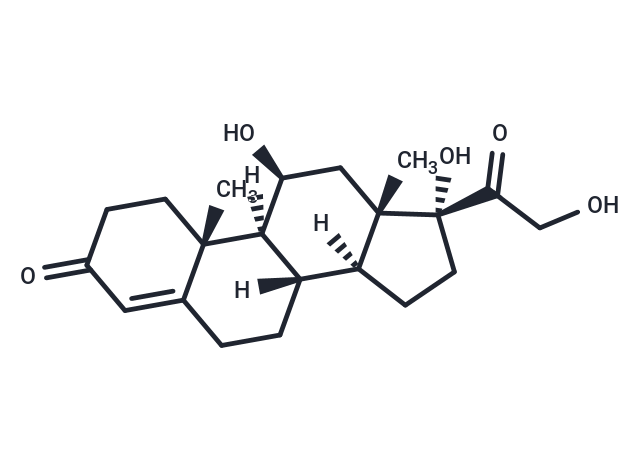
Cas No. 50-23-7
Custom-made molecule. TargetMol’s expert synthesis team delivers cost-effective solutions. Contact us for inquiries. Committed to serving you.
For research use only—not for human use. No sales to individuals. Use as intended only.
Select Batch
Purity:99.95%
Color:White
Product Introduction
Bioactivity
Chemical Properties
Storage & Solubility Information
| Description | Hydrocortisone (Cortisol) is a glucocorticoid hormone secreted by the adrenocortex. Hydrocortisone agonizes the glucocorticoid receptor, which promotes proteolytic metabolism, gluconeogenesis, capillary wall stabilization, and renal calcium excretion, as well as suppressing immune and inflammatory responses. |
| Targets & IC50 | NF-κB:15.52 nM, GR:91 nM (Ki), LTC4:3.6 nM, PGD2:480 nM, PGE2:750 nM, IFN-γ (Equine):0.086 μM |
| In vitro | METHODS: Human articular chondrocytes were cultured in medium containing Hydrocortisone (0.05-1.0 μg/mL), and the relevant indexes were measured by Flow Cytometry. RESULTS: The catabolic signaling pathway of chondrocytes treated with 0.05 μg/mL Hydrocortisone was reduced, and the ability to synthesize ECM macromolecules was enhanced. [1] METHODS: Porcine brain capillary endothelial cells PBCEC were cultured with medium containing Hydrocortisone (550 nM) for seven days, and the cytoskeleton was examined using fluorescence microscopy. RESULTS: Hydrocortisone-induced cytoskeletal rearrangement. [2] |
| In vivo | In ex vivo guinea pig hearts, Hydrocortisone reduces post-ischemic oxidative stress, perfusion pressure, and effusion formation. Within the human cerebral microvascular endothelial cell line hCMEC/D3, Hydrocortisone prevents endothelial barrier disruption induced by pro-inflammatory stimulation (administration of TNFα), partly by maintaining occludin levels. Hydrocortisone induces class-switch recombination from Sμ to Sε in IL-4-treated B cells, supporting a model for sequential isotype transformation from IgM to IgE through IgG4. Following dendritic cell treatment, Hydrocortisone decreases the expression of MHC class II molecules, the dendritic-specific marker CD83, and costimulatory molecule CD86, while significantly reducing IL-12 secretion. Additionally, it inhibits the increase of IL-4 (induced by IFN-γ) but does not affect IL-5. Hydrocortisone lowers T cell proliferation in dendritic cells. It prevents TNF-α-induced severe degradation of glycocalyx, increases in coronary resistance, vascular leakage and permeability, hydroxyethyl starch, and causes degranulation of mast cells in ex vivo guinea pig hearts. Hydrocortisone inhibits the shedding of multiligand glycosaminoglycans-1, heparan sulfate, and hyaluronic acid post-ischemia and suppresses the release of histamine from resident mast cells. |
| Synonyms | Cortisol |
| Cell Research | Cells are plated on top of collagen IV-coated transwell chambers for six-well plates (24 mm diameter, membrane material: polyethylene terephthalate (PET), 0.4 μm pores, pore density 1.6×10⁶?cm2) at densities of 2.5×10⁴?cells cm2?per well. When they have reached confluence at day 5, the different experimental sets of cells are transferred to differentiation medium containing reduced amounts of FCS and treated with TNFα or hydrocortisone as indicated. |
| Molecular Weight | 362.46 |
| Formula | C21H30O5 |
| Cas No. | 50-23-7 |
| Smiles | C[C@@]12[C@]([C@]3([C@@]([C@]4(C)C(CC3)=CC(=O)CC4)([C@@H](O)C1)19)19)(CC[C@@]2(C(CO)=O)O)19 |
| Relative Density. | 1.28g/cm3 |
| Storage | Keep away from direct sunlight Powder: -20°C for 3 years | In solvent: -80°C for 1 year Shipping with blue ice/Shipping at ambient temperature. | ||||||||||||||||||||||||||||||||||||||||
| Solubility Information | DMSO: 127.5 mg/mL (351.76 mM), Sonication is recommended.  Ethanol: 22 mg/mL (60.7 mM), Sonication is recommended. | ||||||||||||||||||||||||||||||||||||||||
| In Vivo Formulation | 10% DMSO+40% PEG300+5% Tween 80+45% Saline: 6.8 mg/mL (18.76 mM), Solution. Please add the solvents sequentially, clarifying the solution as much as possible before adding the next one. Dissolve by heating and/or sonication if necessary. Working solution is recommended to be prepared and used immediately. The formulation provided above is for reference purposes only. In vivo formulations may vary and should be modified based on specific experimental conditions. | ||||||||||||||||||||||||||||||||||||||||
Solution Preparation Table | |||||||||||||||||||||||||||||||||||||||||
Ethanol/DMSO
DMSO
Note : The dilution table applies only to solid products. For liquid products, please calculate the stock solution based on the stated concentration and/or density. | |||||||||||||||||||||||||||||||||||||||||