

3-Methyladenine [5142-23-4]

Referência T1879-50mg
Tamanho : 50mg
Marca : TargetMol
3-Methyladenine
(Synonyms: NSC 66389, 3-MA) Copy Product Info
3-Methyladenine (3-MA) is a PI3K inhibitor that selectively inhibits class IB PI3Kγ (IC50 = 60 μM) and class III VPS34 (IC50 = 25 μM). 3-Methyladenine inhibits autophagy.
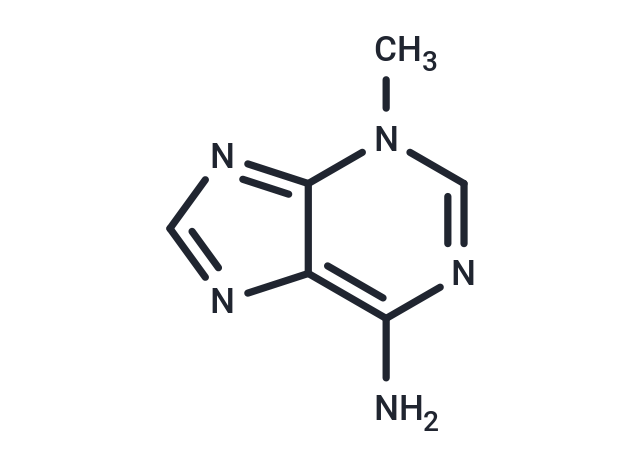
Cas No. 5142-23-4
For research use only—not for human use. No sales to individuals. Use as intended only.
Select Batch
Purity:99.57%
Color:White
COA HPLC
Product Information
Bioactivity
Chemical Properties
Storage & Solubility Information
| Description | 3-Methyladenine (3-MA) is a PI3K inhibitor that selectively inhibits class IB PI3Kγ (IC50 = 60 μM) and class III VPS34 (IC50 = 25 μM). 3-Methyladenine inhibits autophagy. |
| Targets & IC50 | Autophagy:1.21 mM, MIAPaCa2 cells:> 100 μM, PI3Kγ:60 μM (HeLa cells), VPS34:25 μM (HeLa cells) |
| In vitro | Method: Human cervical cancer cells HeLa were treated with 3-Methyladenine (2.5-10 mM) for 48 h. Cell growth inhibition was detected by Trypan blue dye exclusion assay. Result: 3-Methyladenine decreased HeLa cell viability in a time- and dose-dependent manner. [1] Method: Adipocytes 3T3-L1 were treated with 3-Methyladenine (5 mM) for 4 h in the absence of serum, and the expression levels of target proteins were detected by Western Blot. Result: 3-Methyladenine significantly decreased the intracellular level of LC3-II, a marker of autophagy, and increased the expression of p62, indicating that 3-Methyladenine was effective in inhibiting autophagy. [2] Method: Mouse melanoma cells B16 were treated with 2DG (5 mM), rotenone (1 μM) and 3-Methyladenine (1.2-5 mM) for 24 h. Cytotoxicity was detected by LDH release assay. Result: 3-Methyladenine dose-dependently reduced the up-regulation of LDH release induced by 2DG/rotenone. 3-Methyladenine protected tumor cells from inhibition of glycolysis and mitochondrial respiration. [3] |
| In vivo | Method: To investigate the effects of 3-Methyladenine on atherosclerosis, 3-Methyladenine (30 mg/kg) was injected intraperitoneally into HFD-fed ApoE-/- mice twice weekly for eight weeks. Result: In mice fed a high-fat diet, 3-Methyladenine treatment significantly reduced the size of atherosclerotic plaques and increased the stability of the lesions. 3-Methyladenine has multiple atheroprotective effects on atherosclerosis, including modulation of macrophage autophagy and foam cell formation as well as alteration of the immune microenvironment. [4] Method: To investigate the regulatory role of autophagy, a single dose of 3-Methyladenine (15 mg/kg ) was administered intraperitoneally to LPS-induced endotoxic shock in C57/BL6 mice. Result: Animals treated with LPS in combination with 3-Methyladenine showed increased survival and decreased serum inflammatory mediators TNF-α and IL-6 after endotoxemia. [5] |
| Synonyms | NSC 66389, 3-MA |
| Cell Research | Cells were seeded in an 8-well coverglass-bottomed chamber for 24 hours (6×10^3 cells per well). Images were acquired automatically at multiple locations on the coverglass using a Nikon TE2000E inverted microscope fitted with a 20× Nikon Plan Apo objective, a linearly-encoded stage, and a Hamamatsu Orca-ER CCD camera. A mercury-arc lamp with two neutral density filters (for a total 128-fold reduction in intensity) was used for fluorescence illumination. The microscope was controlled using NIS-Elements Advanced Research software and housed in a custom-designed 37°C chamber with a secondary internal chamber that delivered humidified 5% CO2. Fluorescence and differential interference contrast images were obtained every 10 min for a period of 48 hours. To analyze live cell imaging movies, the time-lapse records of live cell imaging experiments were exported as an image series and analyzed manually using NIS-Elements Advanced Research software. The criteria for analyses were described previously, and lagging chromosomes in prometaphase were defined as the red fluorescence-positive materials that lingered outside the roughly formed metaphase plate for more than 3 frames (30 min) [2]. |
| Animal Research | All rats were fasted for 12 h with free access to water prior to operation. After anesthesia by intraperitoneal (i.p.) injection of 2% sodium pentobarbital (0.25 mL/100 g), they were laid and fixed on the table, routinely shaven, disinfected, and draped. The rat SAP model was induced by 0.1 mL/min speed uniformly retrograde infusion of a freshly prepared 3.5% sodium taurocholate solution (0.1 mL/100 g) into the biliopancreatic duct after laparotomy. Equivalent volume of normal saline solution was substituted for 3.5% sodium taurocholate solution in the sham-operation (SO) control group. The incision was closed with a continuous 3-0-silk suture, and 2 mL/100 g of saline was injected into the back subcutaneously to compensate for the fluid loss. 180 rats were randomly divided into four groups: (1) Acanthopanax treatment group (Aca group, n = 45) where the rats were injected with 0.2% Acanthopanax injection at a dose of 3.5 mg/100 g 3 h after successful modeling via the vena caudalis once, knowing that this dosage was effective as proven in our previous experiment; (2) 3-Methyladenine treatment group (3-methyladenine group, n = 45) where the rats were injected with 100 nmol/μL 3-methyladenine solution at a dose of 1.5 mg/100 g 3 h after successful modeling via the intraperitoneal route once, knowing that this dosage was effective as proven in the literature [6]; (3) SAP model group (SAP group, n = 45) where these rats received an equivalent volume of the normal saline instead of Acanthopanax injection 3 h after successful modeling via the vena caudalis once; (4) SO group (control, n = 45) where these rats received an equivalent volume of the normal saline instead of Acanthopanax injection 3 h after successful sham-operation via the vena caudalis once. The 45 animals in each of the four groups were equally randomized into 3, 12, and 24 h subgroups for postoperative observations [4]. |
| Molecular Weight | 149.153 |
| Formula | C6H7N5 |
| Cas No. | 5142-23-4 |
| Smiles | NC1=C2N=CN=C2N(C)C=N1 |
| Relative Density. | 1.6g/cm3 |
| Storage | The compound is unstable in solution. Please use soon, Pure form: -20°C for 3 years Shipping with blue ice/Shipping at ambient temperature. | |||||||||||||||||||||||||
| Solubility Information | DMSO: 10.90 mg/mL (73.08 mM), Sonication is recommended. The compound is unstable in solution, please use soon.  Ethanol: 4.00 mg/mL (26.82 mM), Sonication is recommended. The compound is unstable in solution, please use soon. H2O: 3.00 mg/mL (20.11 mM), Sonication and heating are recommended. (The compound is unstable in solution, please use soon.) | |||||||||||||||||||||||||
| In Vivo Formulation | 10% DMSO+90% Saline: 1.09 mg/mL (7.31 mM), Solution. Please add the solvents sequentially, clarifying the solution as much as possible before adding the next one. Dissolve by heating and/or sonication if necessary. Working solution is recommended to be prepared and used immediately. The formulation provided above is for reference purposes only. In vivo formulations may vary and should be modified based on specific experimental conditions. | |||||||||||||||||||||||||
Solution Preparation Table | ||||||||||||||||||||||||||
H2O/Ethanol/DMSO
Note : The dilution table applies only to solid products. For liquid products, please calculate the stock solution based on the stated concentration and/or density. | ||||||||||||||||||||||||||