BMP4 Antibody - N-terminal region - Biotin

Referência ARP63063_P050-Biotin
Tamanho : 100ul
Marca : Aviva Systems Biology
BMP4 Antibody - N-terminal region : Biotin (ARP63063_P050-Biotin)
| Datasheets/Manuals | Printable datasheet for anti-BMP4 (ARP63063_P050-Biotin) antibody |
|---|
| Predicted Species Reactivity | Human, Mouse, Rat, Cow, Dog, Goat, Guinea Pig, Horse, Rabbit, Sheep |
|---|---|
| Product Format | Liquid. Purified antibody supplied in 1x PBS buffer. |
| Clonality | Polyclonal |
| Host | Rabbit |
| Conjugation | Biotin |
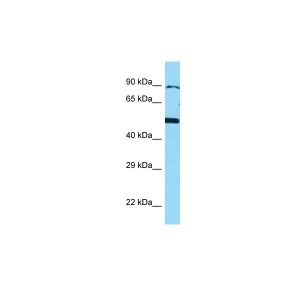
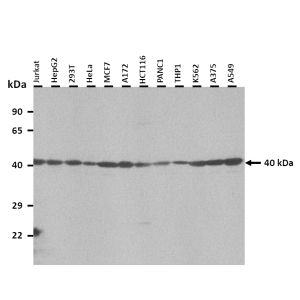
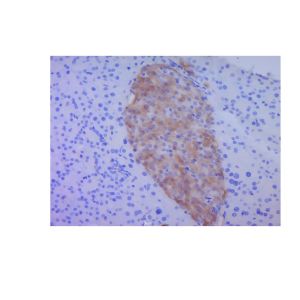
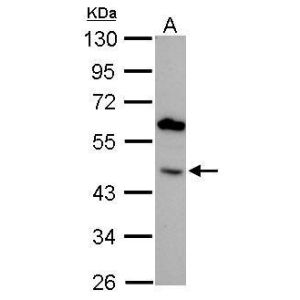
| Application | WB |
| Reconstitution and Storage | All conjugated antibodies should be stored in light-protected vials or covered with a light protecting material (i.e. aluminum foil). Conjugated antibodies are stable for at least 12 months at 4C. If longer storage is desired (24 months), conjugates may be diluted with up to 50% glycerol and stored at -20C to -80C. Freezing and thawing conjugated antibodies will compromise enzyme activity as well as antibody binding. |
| Purification | Affinity Purified |
| Predicted Homology Based on Immunogen Sequence | Cow: 100%; Dog: 100%; Goat: 100%; Guinea Pig: 100%; Horse: 100%; Human: 100%; Mouse: 100%; Rabbit: 100%; Rat: 100%; Sheep: 100% |
| Peptide Sequence | Synthetic peptide located within the following region: HASLIPETGKKKVAEIQGHAGGRRSGQSHELLRDFEATLLQMFGLRRRPQ |
| Concentration | 0.5 mg/ml |
| Blocking Peptide | For anti-BMP4 (ARP63063_P050-Biotin) antibody is Catalog # AAP63063 |
| Gene Symbol | BMP4 |
|---|---|
| Gene Full Name | Bone morphogenetic protein 4 |
| Alias Symbols | ZYME, BMP2B, OFC11, BMP2B1, MCOPS6 |
| NCBI Gene Id | 652 |
| Protein Name | Bone morphogenetic protein 4 |
| Description of Target | The protein encoded by this gene is a member of the bone morphogenetic protein family which is part of the transforming growth factor-beta superfamily. The superfamily includes large families of growth and differentiation factors. Bone morphogenetic proteins were originally identified by an ability of demineralized bone extract to induce endochondral osteogenesis in vivo in an extraskeletal site. This particular family member plays an important role in the onset of endochondral bone formation in humans, and a reduction in expression has been associated with a variety of bone diseases, including the heritable disorder Fibrodysplasia Ossificans Progressiva. Alternative splicing in the 5' untranslated region of this gene has been described and three variants are described, all encoding an identical protein. |
| Uniprot ID | P12644 |
| Protein Accession # | NP_570911 |
| Nucleotide Accession # | NM_130850 |
| Protein Size (# AA) | 408 |
| Molecular Weight | 45kDa |
| Protein Interactions | BMPR2; ZFYVE9; UBC; BGN; GREM2; BMPER; SOSTDC1; CHRDL2; STAP2; BMPR1B; NOG; BMP8B; HTRA1; BMPR1A; CHRDL1; BMP4; TWSG1; CHRD; |