


For the quantitative determination of creatinine in serum and plasma samples.
Creatinine Assay for Serum & Plasma
Creatinine Assay for Serum & Plasma
Contact Us for Bulk Request
Product Description
Specifications
| Size | 2 Plate Kit, 4 Plate Kit |
| Sensitivity | 0.5 mg/dL |
| Specificity | The RayBio Creatinine assay is designed to measure Creatinine in Serum & Plasma. |
| Compatible Sample Types | Plasma, Serum |
| Quantitative/Semi-Quantitative | Quantitative |
| Solid Support | 96-well Microplate |
| Method Of Detection | Colorimetric |
| Research Area | Energy Metabolism, Liver & Renal Function |
| Shipping Type | Blue ice |
| Storage | 2-8°C |
Related Products
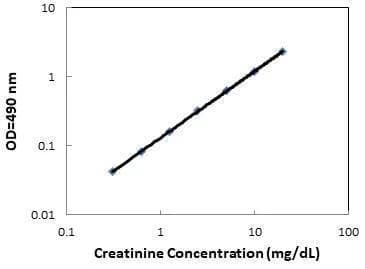
Creatinine Assay for Urine
As low as $249.00
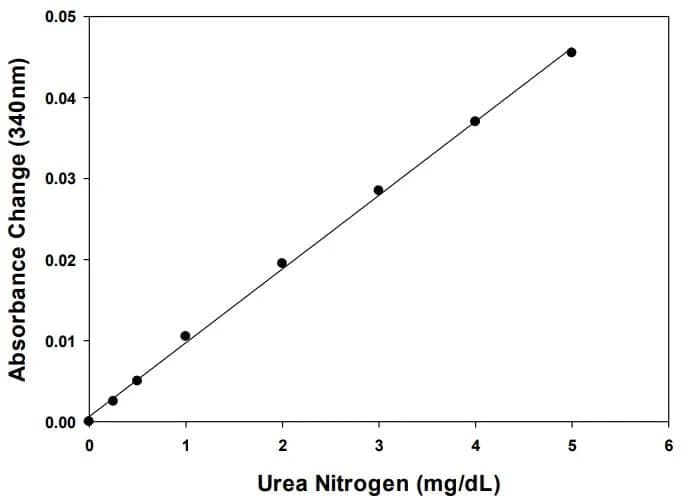
Urea Nitrogen (BUN) Detection Assay Kit (Colorimetric)
As low as $299.00
Introduction
Creatinine is a metabolite waste product of phospho-Creatine (p-Creatine), a molecule used as a store for high-energy phosphate that can be utilized by muscles and other tissues for the production of ATP. Dietary intake and de novo synthesis from the amino acids arginine, glycine, and methionine in the kidney and liver are the primary sources of Creatine. Creatine and p-Creatine are converted non-enzymatically to the metabolite Creatinine, which diffuses into the blood, is filtered through the kidneys, and is then secreted into urine. In vivo, this conversion appears to be irreversible and in vitro it is favored by higher temperatures and lower pH. Some Creatinine may form via p-Creatinine as well. Under normal conditions, Creatinine's formation occurs at a rate that is relatively constant. For instance, in humans approximately 2% of the Creatine/p-Creatine pool is converted to Creatinine daily. This predictability makes Creatinine a useful tool for normalizing the levels of other molecules found in urine. In addition, altered Creatinine levels can be used as an indicator of kidney dysfunction, or may be associated with other conditions that result in decreased renal blood flow. Some examples include diabetes and cardiovascular disease. The RayBio® Creatinine assay is a 7 minute chemical analysis designed to measure Creatinine in Serum/Plasma.
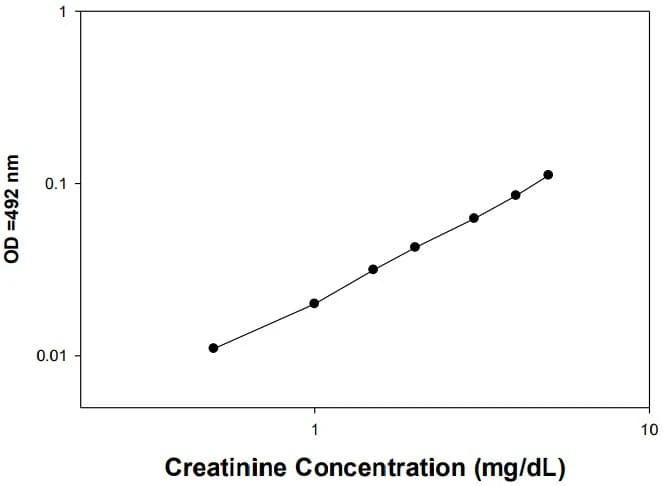
The RayBio Creatinine Assay in an in vitro quantitative assay for the detection of creatinine based on the Jaffe reaction. In this method, creatinine is treated with an alkaline picrate solution to yield a bright yellow/orange complex. The rate of color development is directly proportional to the concentration of creatinine in the sample and is measured at an absorbance at 492nm. Unknown samples are compared to the standard curve. The kinetic nature of the assay eliminates interference from extraneous serum contaminants, such as lipids and bilirubin.
Application Notes
Kit Components
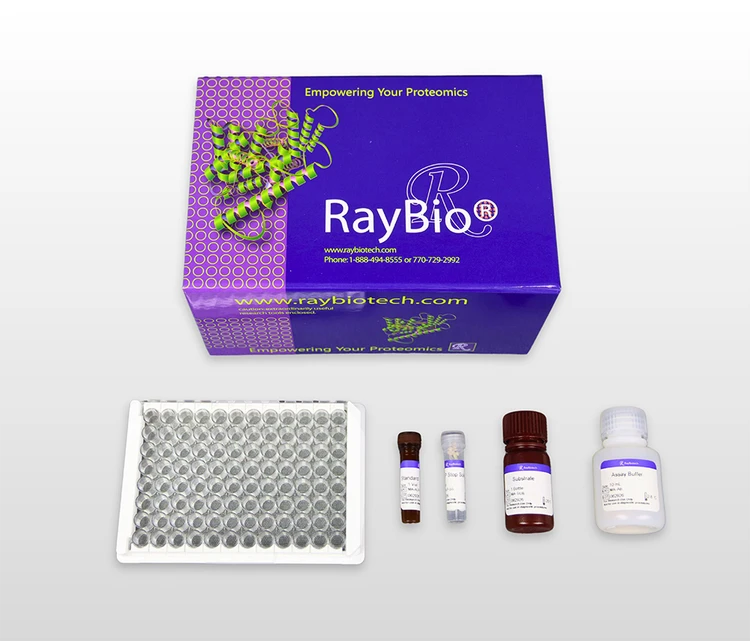
- 96-well Strip Microplate
- Creatinine Standard
- Detection Reagent
- Reaction Buffer I
- Reaction Buffer II
Other Materials Required
- Microplate reader capable of measuring absorbance at 492 nm
- Precision pipettes to deliver 2 µl to 1 ml volumes
- Distilled or deionized water
- Tubes to prepare standard or sample dilutions
Protocol Outline
- Bring all reagents and samples to room temperature before use. It is recommended that all standards and samples be run at least in duplicate.
- Add 15 μL standard (See Reagent Preparation Section B) and sample (see Reagent Preparation Section C) to appropriate wells.
- Add 100 μL Reaction Solution (see Reagent Preparation Section A) to each well.
- Add 100 μL Detection Solution to each well, and immediately start timing the reaction.
- Immediately read and record the absorbance at 492nm.
- Continue incubating the plate at room temperature.
- At seven minutes, read and record the absorbance at 492nm.
Storage/Stability
The entire kit should be stored at 2-8°C for up to 6 months from the date of shipment. Do not use past kit expiration date.
citations
ZBiotics ameliorates T2DM-induced histopathological damage in liver, kidney and adipose tissues by modulating the NOD-like receptor signaling in Wistar rats
- Species:
- Rat
- Sample Type:
- Serum (T2DM wistar rats)
- Year:
- 2025
- Journal Name:
- Diabetology & Metabolic Syndrome
- PubMed ID:
- 39905472
Acute effects of lactate infusion on metabolism, AD biomarkers, and cognition: The LEAN study
- Species:
- Human
- Sample Type:
- Plasma
- Year:
- 2025
- Journal Name:
- Alzheimer's & dementia : the journal of the Alzheimer's Association
- PubMed ID:
- 41376120
Comprehensive machine learning models for predicting therapeutic targets in type 2 diabetes utilizing molecular and biochemical features in rats
- Species:
- Rat
- Sample Type:
- Serum (type 2 diabetes model)
- Year:
- 2024
- Journal Name:
- Frontiers in Endocrinology
- PubMed ID:
- 38854687