

Ethaverine hydrochloride [985-13-7]

Referência T0369-5mg
Tamanho : 5mg
Marca : TargetMol
Ethaverine hydrochloride
(Synonyms: Papetherine, Ethaquin, Consenil) Copy Product Info

Ethaverine hydrochloride is a homologue of papaverine and is used as a vasodilator and antispasmodic.[2]
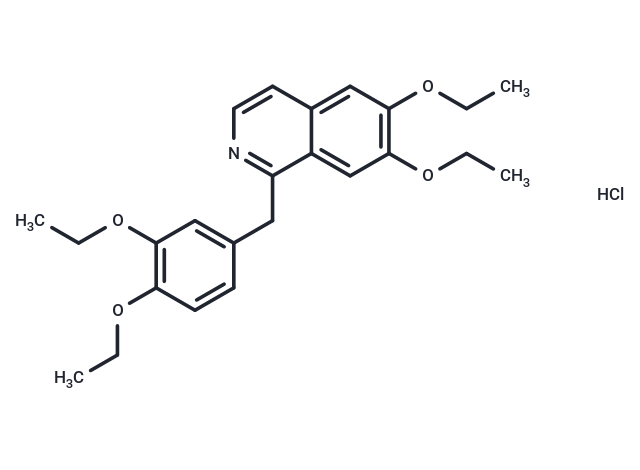
Cas No. 985-13-7
For research use only—not for human use. No sales to individuals. Use as intended only.
Select Batch
Purity:99.73%
Appearance:Solid
Color:White to Yellow
COA LCMS HNMR MS
Product Introduction
Ethaverine hydrochloride AI Summary
Ethaverine hydrochloride exhibits a diverse range of bioactivities, demonstrating potency in several biological assays. It functions as an enhancer of SMN2 splice variant expression and inhibits multiple targets, including ROR gamma transcriptional activity, the ERK signaling pathway, 15-human lipoxygenase 2, Polymerase Kappa, USP1/UAF1, human tyrosyl-DNA phosphodiesterase 1 (TDP1), as well as both Vaccinia Orthopoxvirus and Marburg Virus entry into cells. Additionally, this compound effectively blocks Ebola Virus entry. Specifically, Ethaverine hydrochloride inhibits sodium fluorescein uptake in both OATP1B3-transfected CHO cells and OATP1B1-transfected CHO cells at a concentration of 10 µM, with respective inhibition percentages of 156.16% and 524.92%. It also exhibits moderate activity in reducing the viability of SARS-CoV-2 infected Vero E6 cells, with an inhibition index of 0.4908. Moreover, the compound shows strong antiviral activity against SARS-CoV-2, evidenced by a 99.42% inhibition of virus-induced cytotoxicity in Caco-2 cells at 10 µM after 48 hours and a low IC50 value of 640.0 nM. It has a selectivity index of 17.0, suggesting a favorable therapeutic profile. However, it shows 11.3% inhibition of the SARS-CoV-2 3CL-Pro protease at 20 µM. Despite this, the assay results for VERO-6 cells indicated an inhibition percentage of -0.08% under the tested conditions. Overall, Ethaverine hydrochloride is a multifaceted agent with significant potential across various biological and antiviral applications..
Note: Summary generated by AI. Data source: ChEMBL 
Bioactivity
Chemical Properties
Storage & Solubility Information
| Description | Ethaverine hydrochloride is a homologue of papaverine and is used as a vasodilator and antispasmodic.[2] |
| In vitro | METHODS: The inhibitory effect of ethaverine on dopamine content in PC12 cells was studied. RESULTS Ethaverine reduced dopamine content in PC12 cells in a concentration-dependent manner. At a concentration of 1.0 μM, dopamine content was inhibited by 33.6% within 24-48 hours. The IC50 value of ethaverine was 1.4 μM. 2.0 μM ethaverine reduced dopamine content after 6 hours of action. Tyrosine hydroxylase (TH) was inhibited after 6 hours of ethaverine treatment in PC12 cells, and the activity remained at a reduced level until 36 hours (the inhibition rate was 12-22% at 2.0 μM). [1] Ethaverine (10 μM) treatment in PC12 cells reduces catecholamine secretion by blocking L-type voltage-sensitive Ca2+ channels. [2] |
| In vivo | METHODS: In a short-term experiment on 11 guinea pigs, the effect of Ethaverine hydrochloride on cochlear microcirculation was observed (2/5 and /10 mg/kg, i.v) for 10 minutes. In these experiments, intracochlear PO2, intracochlear potential (EP), cochlear microphonic (CM) potential, and blood pressure (BP) were recorded. Intracochlear PO2 was measured polarographically in the mid-level using gold electrodes. RESULTS Ethaverine hydrochloride at doses of 5 and 10 mg/kg caused a significant increase in intracochlear PO2 for 35 to 90 minutes, even with a temporary decrease in blood pressure. At the same time, this improvement in cochlear microcirculation was observed to coincide with an increase in CM potential. The decrease in EP may be the result of a decrease in blood pressure and a direct effect of Ethaverine hydrochloride on EP production. [3] |
| Synonyms | Papetherine, Ethaquin, Consenil |
| Molecular Weight | 431.96 |
| Formula | C24H30ClNO4 |
| Cas No. | 985-13-7 |
| Smiles | CCOc1c(OCC)cc(Cc2nccc3cc(OCC)c(OCC)cc23)cc1.Cl |
| Relative Density. | 1.104g/cm3 |
| Storage | Powder: -20°C for 3 years | In solvent: -80°C for 1 year Shipping with blue ice/Shipping at ambient temperature. | ||||||||||||||||||||||||||||||||||||||||
| Solubility Information | H2O: 100 mg/mL (231.5 mM), Sonication is recommended.  DMSO: 16 mg/mL (37.04 mM), Sonication is recommended. | ||||||||||||||||||||||||||||||||||||||||
| In Vivo Formulation | 10% DMSO+90% Saline: 1.6 mg/mL (3.7 mM), Solution. Please add the solvents sequentially, clarifying the solution as much as possible before adding the next one. Dissolve by heating and/or sonication if necessary. Working solution is recommended to be prepared and used immediately. The formulation provided above is for reference purposes only. In vivo formulations may vary and should be modified based on specific experimental conditions. | ||||||||||||||||||||||||||||||||||||||||
Solution Preparation Table | |||||||||||||||||||||||||||||||||||||||||
DMSO/H2O
H2O
Note : The dilution table applies only to solid products. For liquid products, please calculate the stock solution based on the stated concentration and/or density. | |||||||||||||||||||||||||||||||||||||||||