

Indo-1, AM Ester

Referência 50044
Tamanho : 1MG
Marca : Biotium
Indo-1, AM Ester
Indo-1, AM ester is membrane-permeant and thus can be loaded into cells via incubation. Because of the relatively low water solubility of the AM ester, Pluronic F-127, a mild detergent, is often used as a dispersing agent to facilitate cell loading.
Product Description
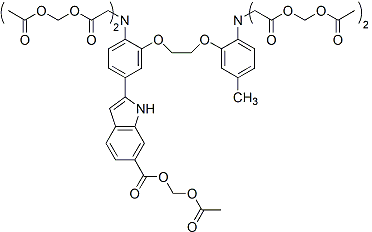
Indo-1, AM ester is membrane-permeant and thus can be loaded into cells via incubation. Because of the relatively low water solubility of the AM ester, the mild detergent Pluronic® F-127 (cat# 59004) is often used as a dispersing agent to facilitate cell loading. Indo-1-AM Ester itself does not bind Ca2+, but it is readily hydrolyzed to indo-1 by endogenous esterases once it enters cells. For more information on indo-1, see cat# 50040.
- Light yellow solid soluble in DMSO
- Store desiccated at -20°C and protect from light, especially in solution
- C47H51N3O22
- MW: 1010
- [112926-02-0]
BAPTA-based ion indicators like Indo-1 have been shown to be fixable in situ by EDC/EDAC (cat# 59002). The fixation of indicator dyes is useful for downstream immunofluorescence and IHC studies (Cell Calcium 1997, 21(3), 175).
As the indicator does not covalently bind to cellular components, it may be actively effluxed from the cell by organic anion transporters. The rate of efflux increases with temperature, and may vary between cell types, resulting in variable retention times of a few minutes to hours. Experiments using indicators in cells usually are performed within one or two hours of loading, but it may be possible to re-load cells with indicator if needed. The organic anion transporter inhibitor Probenecid (#50027) can be used to slow the rate of indicator efflux from cells.
Technology

Product Attributes
CAS number
Size
Cell permeability
Indicator type
Excitation/Emission
Documents, Protocols, SDS and COA

Protocols
SDS
COA
Request the Certificate of AnalysisReferences
- J Neurophysiol 67, 704 (1992), DOI: 10.1152/jn.1992.67.3.704
- J Biol Chem 262, 15041 (1987), PMID: 3667622
- J. Biol. Chem. 261, 9710 (1986), PMID: 3755432
- Methods Cell Biol, 99, 113, (2021), DOI: 10.1016/B978-0-12-374841-6.00005-0