


Monoclonal Antibody to Dnmt1 (Clone: ABM13B2)
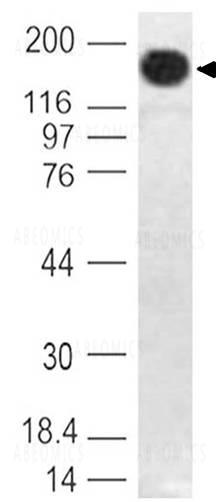
Fig-1: Western blot analysis of DNMT1. Anti- DNMT1 antibody (Clone: ABM13B2) was used at 2 µg/ml on mouse Embryonic liver lysate.
| Format : | Purified |
| Amount : | 100 µg |
| Isotype : | Mouse IgG1 Kappa |
| Purification : | Protein G Chromatography |
| Content : | 25 µg in 50 µl/100 µg in 200 µl PBS containing 0.05% BSA and 0.05% sodium azide. Sodium azide is highly toxic. |
| Storage condition : | Store the antibody at 4°C, stable for 6 months. For long-term storage, store at -20°C. Avoid repeated freeze and thaw cycles. |
Dnmt1(DNA (cytosine-5-)-methyltransferase 1 ) is one of the most abundant DNA methyltransferase in mammalian tissues, where it associates with the replication machinery and restores symmetrical methylation at hemimethylated CpG sites generated by the semi-conservative DNA replication process. Dnmt1 comprises a regulatory N-terminal region and a C-terminal catalytic domain connected by a linker of seven glycine-lysine repeats. The N-terminal part contains a PCNA binding domain (PBD), a heterochromatin targeting sequence (TS), a CXXC-type zinc finger domain and two Bromo-Adjacent Homology domains (BAH1 and BAH2). The C-terminal domains of mammalian Dnmts contain all ten catalytic motifs identified in bacterial DNA (cytosine-5) methyltransferases. Dnmt1 maintains methylation patterns with high fidelity and is essential for embryonic development and genome integrity. The molecules interacting with Dnmt1, including RNA polymerase II, some RNA-binding proteins, and some specific Dnmt1-inhibitory RNA molecules are involved in chromatin organization, DNA repair, cell cycle regulation, and apoptosis.
Western blot analysis: 2-4 µg/ml, Immunohistochemical analysis: 5 µg/ml, FACS analysis: 0.5 µg/10^6 cells
For Research Use Only. Not for use in diagnostic/therapeutics procedures.
| Subcellular location: | Nucleus |
| Post transnational modification: | Ubiquitinated by UHRF1; interaction with USP7 counteracts ubiquitination by UHRF1 by promoting deubiquitination and preventing degradation by the proteasome. |
| Tissue Specificity: | Ubiquitous; highly expressed in fetal tissues, heart, kidney, placenta, peripheral blood mononuclear cells, and expressed at lower levels in spleen, lung, brain, small intestine, colon, liver, and skeletal muscle. Isoform 2 is less expressed than isoform 1. |
| BioGrid: | 108123. 92 interactions. |
| There are currently no product reviews |