


Inquiry
Dispatch Time: About 3 working days
- Product Name
- PE-Cy7 Anti-Human CD23 Antibody(EBVCS2)
- Catalogue No.
- PC7-30117
- Form
- liquid
- Conjugation
- PE-Cy7
- Conjugation Information
- PE-Cy7 is designed to be excited by the Blue (488 nm), Green (532 nm) and yellow-green (561 nm) lasers and detected using an optical filter centered near 775 nm (e.g., a 780/60 nm bandpass filter).
- Clonality
- Monoclonal
- Isotype
- IgG1, κ
- Clone ID
- EBVCS2
- Storage
- PBS with 0. 1% sodium azide, 1%BSA, pH 7.3, 2-8℃ for 12 months (Avoid repeated freeze / thaw cycles.)
Immunogen
- Alternative Names
- Leu-20|FcεRII|IgE Fc Receptor|BLAST-2|B6|Low affinity IgE receptor antibody
- UniProt ID
- P06734
Application
- Tested Applications
- FC
- Recommended dilution
- Volume per test: 5μL. Each lot of this antibody is quality control tested by flow cytometric analysis. The amount of the reagent is suggested to be used 5 µL of antibody per test (million cells in 100 µL staining volume or per 100 µL of whole blood). Please check your vial before the experiment. Since applications vary, the appropriate dilutions must be determined for individual use.
Validated Images
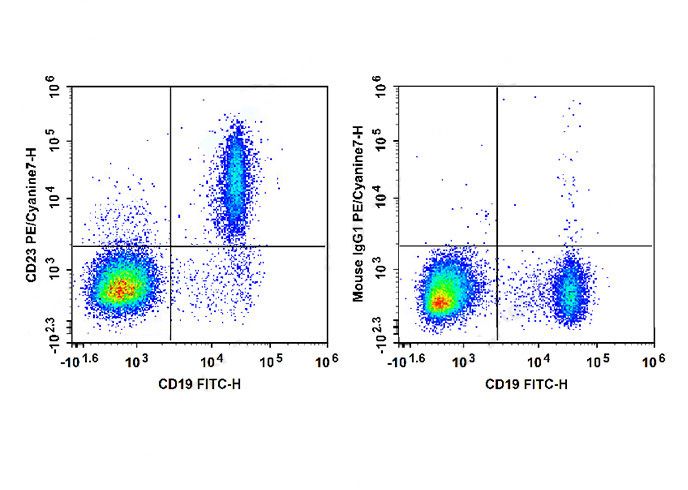 PE-Cy7 Anti-Human CD23 Antibody(EBVCS2)
 - Background
- CD23 is a 45 kD protein, also known as Leu-20, FcεRII, IgE Fc receptor, BLAST-2, B6, and low affinity IgE receptor. It is a member of the Ig family, expressed on most mature B cells, B cells in follicular mantle (but not in proliferating germinal center cells, follicular dendritic cells, monocytes, eosinophils, Langerhans cells, and a subset of T cells (10-15% of tonsillar T cells). CD23 responds to high levels of IgE by downregulating IgE secretion. In human monocytes, CD23 triggering results in release of pro-inflammatory cytokines including TNF-α, IL-1, IL-6, and GM-CSF. CD23 can be proteolytically cleaved to generate soluble CD23 fragments of various molecular weights. In chronic lymphocytic leukemia, levels of soluble CD23 in the serum can be used as a prognostic marker to identify patients at high risk for disease progression. Alternate splicing of exon 2 can also generate two cell-surface isoforms of CD23 differing by 6 amino acids in their cytoplasmic region.