


The RayBiotech Uric Acid Colorimetric Assay Kit is a simple, reproducible, and sensitive tool for measuring uric acid concentration in plasma, serum, cell lysates, urine and other biological liquid samples.
Uric Acid Assay Kit (Colorimetric)
Uric Acid Assay Kit (Colorimetric)
Contact Us for Bulk Request
Product Description
Specifications
| Size | 1 Plate Kit, 2 Plate Kit, 5 Plate Kit |
| Compatible Sample Types | Plasma, Serum, Tissue Lysates, Cell Lysates, Urine |
| Quantitative/Semi-Quantitative | Quantitative |
| Solid Support | 96-well Microplate |
| Method Of Detection | Colorimetric |
| Research Area | Cardiovascular Disease, Inflammation, Oxidative Stress, Liver & Renal Function |
| Shipping Type | Blue ice |
| Storage | 2-8°C |
Related Products

Uric Acid
$83.00
Introduction
Uric Acid serves as the end-product of human purine metabolism, resulting from the oxidation of xanthine and hypoxanthine by xanthine oxidase, and is subsequently excreted in urine. The kidney facilitates the clearance of uric acid through glomerular filtration. However, humans often lack the necessary enzyme called urate oxidase (uricase), and consequently abnormal uric acid levels may accumulate in the bloodstream. Elevated serum uric acid levels, known as hyperuricemia, are associated with insulin resistance, cardiovascular diseases, and gout. Furthermore, increased serum uric acid can serve as an indicator of renal disease.
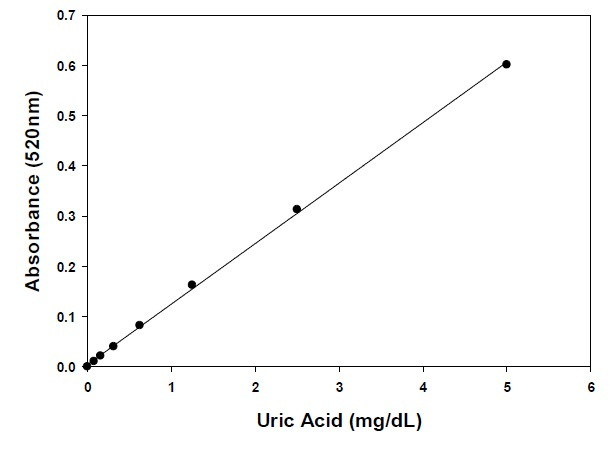
RayBio® Uric Acid Colorimetric Assay Kit provides a simple, reproducible, and sensitive tool for measuring uric acid concentration in plasma, serum, cell lysates, urine and other biological liquid samples. This assay utilizes a coupled enzymatic reaction system. First, uricase catalyzes the conversion of uric acid to allantoin and hydrogen peroxide (H2O2). H2O2, in the presence of horseradish peroxidase, reacts with a colorimetric probe to form a pink-colored product. The optical density measured at 520nm is directly proportional to the uric acid concentration in the sample.
Kit Components
| Component | Size / Description |
|---|---|
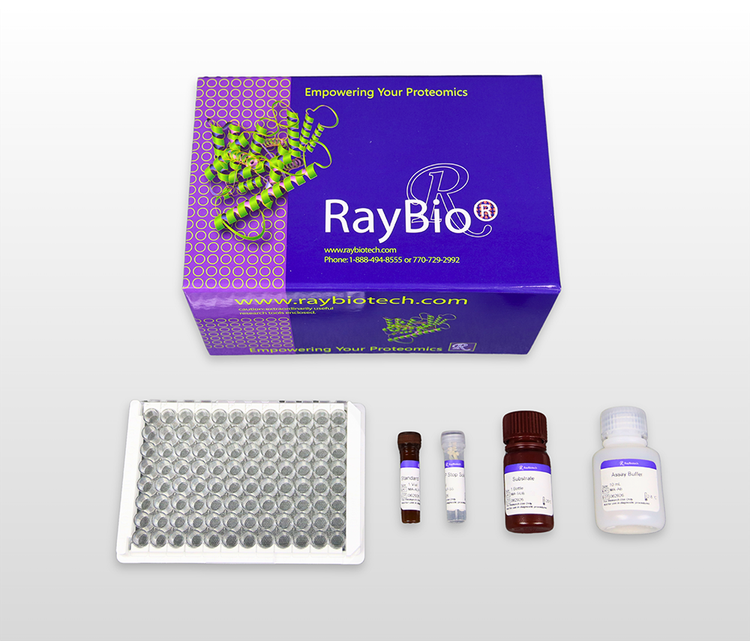
| Microplate | A 96-well (12 strips x 8 wells) plate |
| Sample Buffer | 10 ml |
| Uric Acid Standard | 1 vial (250 μl of 5 mg/dL) |
| Enzyme Mix Solution | 20 ml |
Additional Materials Required
- Microplate reader capable of measuring absorbance at 520 nm
- Precision pipettes to deliver 2 µl to 1 ml volumes
- Multi-channel pipettes to deliver 20 μl to 200 μl volumes
- Tubes to prepare sample dilutions
- Incubator at 37°C.
Assay Procedure Summary
Positive control, sample and Sample Buffer (used as a blank) should be assayed in duplicate or triplicate. A freshly prepared positive control should be used each time the assay is performed.
- Pre-warm the Enzyme Mix Solution at 37°C (in the dark) for at least five minutes.
- Add 40 μL of the diluted Uric Acid standards or samples to the 96-well microtiter plate.
- Initiate the reaction by adding 200 μL of Enzyme Mix Solution to each well (pre-heat reagent at 37°C).
- Cover with the plate cover. Carefully shake the plate for a few seconds to mix.
- Incubate the plate for 10 minutes at 37°C in the dark.
- Measure the absorbance at 520nm using a plate reader.
documents
citations
Combined Omeprazole and Glycyrrhiza glabra L. Extract Attenuate Ethanol-Induced Gastric Ulceration Through Modulation of TLR4/NF-κB/NLRP3 Signaling and Upregulation of PI3K/AKT/mTOR Gene Expression
- Species:
- Rat
- Sample Type:
- Serum (ethanol-induced gastric ulcer rats)
- Year:
- 2026
- Journal Name:
- International Journal of Molecular Sciences
- PubMed ID:
- 42589688
DOSE-RESPONSE DYNAMICS OF A MULTI-MICRONUTRIENT SUPPLEMENTATION ON REPRODUCTIVE HEALTH, REDOX STATUS, METABOLIC BIOMARKERS, AND FOLLICULOGENESIS IN HEALTHY FEMALE ALBINO WISTAR RATS
- Species:
- Rat
- Sample Type:
- Serum
- Year:
- 2026
- Journal Name:
- Genetics and Molecular Research
Enhanced Therapeutic Efficacy of Omeprazole Nanosuspension in Ethanol-Induced Gastric Ulcer: A Focus on Oxidative Stress and Inflammatory Pathways
- Species:
- Rat
- Sample Type:
- Serum (ethanol-induced gastric ulcer)
- Year:
- 2025
- Journal Name:
- Biomolecules
- PubMed ID:
- 40563542