

Tanespimycin [75747-14-7]

Katalog-Nummer T6290-1ml
Size : 1mLx10mM(inDMSO)
Marke : TargetMol
Tanespimycin
(Synonyms: NSC 330507, KOS 953, CP 127374, 17-AAG) Copy Product Info

Tanespimycin (KOS 953) is an Hsp90 inhibitor (IC50=5 nM) and is selective. Tanespimycin depletes intracellular STK38/NDR1 and decreases STK38 kinase activity. Tanespimycin also downregulated stk38 gene expression.
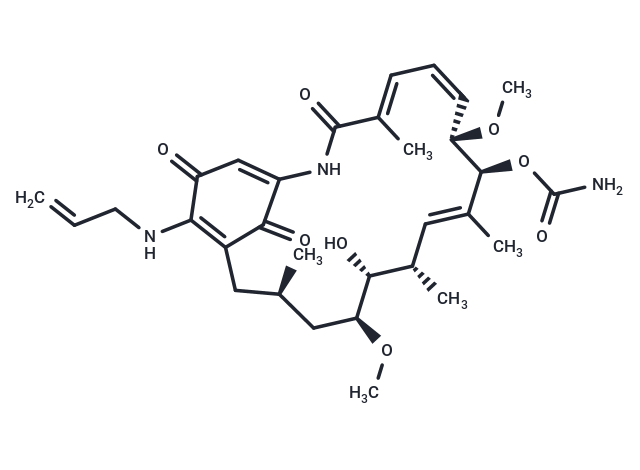
Cas No. 75747-14-7
For research use only—not for human use. No sales to individuals. Use as intended only.
Select Batch
Purity:99.83%
Color:Purple
COA HNMR LCMS
Product Information
Bioactivity
Chemical Properties
Storage & Solubility Information
| Description | Tanespimycin (KOS 953) is an Hsp90 inhibitor (IC50=5 nM) and is selective. Tanespimycin depletes intracellular STK38/NDR1 and decreases STK38 kinase activity. Tanespimycin also downregulated stk38 gene expression. |
| Targets & IC50 | CNE2Z cells:8.41 μM, DU-145 cells:0.282 μM, ECa-109 cells:1.1 μM, HCT116 cells:56.5 nM, K562 cells:0.15 μM, BT-474 cells:0.01 μM, AU565 cells:0.003 μM, HeLa cells:0.2 μM, HT29 cells:0.1 nM, A431 cells:0.069 μM, A549 cells:0.286 μM, A375 cells:1287 nM, HSP90:5 nM, BGC-823 cells:847 nM, HepG2 cells:0.32 μM |
| In vitro | METHODS: Human A-431, A549, BGC-823, HepG2, HUVEC, L02, and MDA-MB-231 cells were treated with Tanespimycin (0-10 μM) for 72 hours, and the cell growth inhibition was detected by MTT assay. RESULTS: Tanespimycin inhibited A-431 (IC50=89 nM), A549 (IC50=81 nM), BGC-823 (IC50=847 nM), HepG2 (IC50=91 nM), HUVEC (IC50=282 nM), and L02 (IC50=99) nM), MDA-MB-231 (IC50=0.28 μM) cell growth. [1] METHODS: CCA cells were treated with Tanespimycin (0.6 μM) for 72 hours, and the expression levels of target proteins were detected by Western Blot. RESULTS: Tanespimycin downregulated Bcl-2, Survivin and Cyclin B1 and upregulated cleaved PARP. [2] |
| In vivo | METHODS: To study the antitumor activity of Tanespimycin, lymphoma-inoculated mice were intraperitoneally injected with Tanespimycin (5-40 mg/kg) every other day for three weeks. RESULTS: Tanespimycin inhibited lymphoma in vivo. [3] |
| Synonyms | NSC 330507, KOS 953, CP 127374, 17-AAG |
| Kinase Assay | Purified native Hsp90 protein or cell lysates in lysis buffer (20 mM HEPES, pH 7.3, 1 mM EDTA, 5 mM MgCl2, 100 mM KCl) were incubated with or without 17-AAG for 30 min at 4 °C, and then incubated with biotin-GM linked to streptavidin magnetic beads for 1 h at 4 °C. Tubes were placed on a magnetic rack, and the unbound supernatant removed. The magnetic beads were washed three times in lysis buffer and heated for 5 min at 95 °C in SDS–PAGE sample buffer. Samples were analyzed on SDS protein gels, and western blots done using indicated antibodies. Bands in the western blots were quantified, and the percentage inhibition of binding of Hsp90 to the biotin-GM was calculated. The IC50 reported is the concentration of 17-AAG needed to cause half-maximal inhibition of binding. For in vitro reconstitution, 5 μM of purified Hsp90 was combined with 1 μM each of Hsp70, Hsp40, p23, and Hop purified proteins [1]. |
| Cell Research | Cells were seeded in 96-well plates at 2,000 cells per well in a final culture volume of 100 μl for 24 h before the addition of increasing concentrations of 17-AAG that was incubated for 5 days. Viable cell number was determined using the Celltiter 96 AQueous Nonradioactive Cell Proliferation Assay. The value of the background absorbance at 490 nm (A490) of wells not containing cells was subtracted. Percentage of viable cells ? (A490 of 17-AAG treated sample/A490 untreated cells) × 100. The IC50 was defined as the concentration that gave rise to 50% viable cell number [1]. |
| Animal Research | B10.BR mice were inoculated with 5×10^5 lymphoma cells through intraperitoneal injection. Seven days following tumor implantation, the mice were I.P. injected with 17-AAG or vehicle (10% DMSO + 40% Cremophor EL: Ethanol (3:1) (v/v) + 50 % PBS) every other day for three weeks. At the cessation of treatment, mice were monitored up to 80 days post tumor cell injection. To determine the effects of 17-AAG on lymphoma initiation in vivo, secondary B10.BR recipient mice were implanted by intraperitoneal injection of 1×10^5 lymphoma cells from the spleens of first-round mice that had been treated with 17-AAG or vehicle. These mice were followed up to 160 days post tumor cell injection to monitor differences in tumor initiation between the mice [4]. |
| Molecular Weight | 585.69 |
| Formula | C31H43N3O8 |
| Cas No. | 75747-14-7 |
| Smiles | CO[C@H]1C[C@H](C)CC2=C(NCC=C)C(=O)C=C(NC(=O)\C(C)=C\C=C/[C@H](OC)[C@@H](OC(N)=O)\C(C)=C\[C@H](C)[C@H]1O)C2=O |
| Relative Density. | 1.21 g/cm3 |
| Storage | Keep away from direct sunlight,Keep away from moisture,Store at low temperature, Powder: -20°C for 3 years | In solvent: -80°C for 1 year Shipping with blue ice/Shipping at ambient temperature. | ||||||||||||||||||||||||||||||
| Solubility Information | DMSO: 50.5 mg/mL (86.22 mM), Sonication is recommended.  | ||||||||||||||||||||||||||||||
| In Vivo Formulation | 10% DMSO+40% PEG300+5% Tween 80+45% Saline: 1 mg/mL (1.71 mM), Sonication is recommended. Please add the solvents sequentially, clarifying the solution as much as possible before adding the next one. Dissolve by heating and/or sonication if necessary. Working solution is recommended to be prepared and used immediately. The formulation provided above is for reference purposes only. In vivo formulations may vary and should be modified based on specific experimental conditions. | ||||||||||||||||||||||||||||||
Solution Preparation Table | |||||||||||||||||||||||||||||||
DMSO
Note : The dilution table applies only to solid products. For liquid products, please calculate the stock solution based on the stated concentration and/or density. | |||||||||||||||||||||||||||||||