

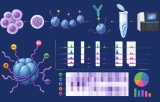
Histone modification analysis examines post-translational changes on histone proteins that regulate chromatin structure and gene expression.
These dynamic marks—primarily methylation, acetylation, phosphorylation, ubiquitination, and sumoylation—occur on specific lysine, arginine, and serine residues, creating combinatorial "codes" interpreted by chromatin readers.
Core Methodologies
Chromatin Immunoprecipitation (ChIP) selectively isolates histone-DNA complexes:
- Fixation preserves protein-DNA interactions
- Chromatin shearing generates 150-300 bp fragments
- Antibody pulldown enriches modified histone fractions
- Quantitative PCR or sequencing reveals genomic occupancy
Western Blotting provides semi-quantitative modification levels from acid-extracted histones.
ELISA Assays deliver high-throughput, absolute quantification of specific marks from nuclear extracts.
Mass Spectrometry profiles combinatorial modifications with single-residue resolution.
Major Histone Modifications
Actylation (H3K9/14/18/27, H4K5/8/12/16):
- Neutralizes lysine charge, opens chromatin
- Recruited by HATs (p300/CBP), removed by HDACs/SRTs
- Associates with active promoters and enhancers
Methylation (H3K4me1/2/3, H3K9me1/2/3, H3K27me1/2/3, H4K20me1/2/3):
- H3K4me3 marks active promoters
- H3K27me3 silences developmental genes (Polycomb)
- H3K9me3 mediates heterochromatin formation
- Writers: SET-domain HMTs; erasers: KDMs/JmjC
Phosphorylation (H3S10, H3T11):
- Mitosis/chromatin condensation marker
- Immediate-early gene activation