


2X Cell Lysis Buffer for use with RayBiotech immunoassay kits (5 ml)
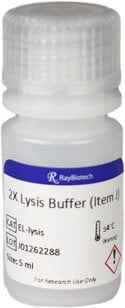
Lysis Buffer (2X)
Lysis Buffer (2X)
Contact Us for Bulk Request
Product Description
Specifications
| Size | 5 mL |
| Shipping Type | Blue ice |
| Storage | 2-8°C |
Related Products
2X Lysis Buffer
As low as $15.00
10X Whole Blood Lysing Solution
As low as $70.00
2X Lysis Buffer for ELISA Kits
2X Lysis Buffer Preparation Instructions
2X Lysis Buffer should be diluted 2-fold with deionized or distilled water. Supplementation with protease or phosphatase inhibitors is recommended. You may use RayBiotech Protease Inhibitor Cocktail (AA-PI), RayBiotech Phosphatase Inhibitor Cocktail Set I (AA-PHI-I) or Phosphatase Inhibitor Cocktail Set II (AA-PHI-II), or the RayBiotech Phosphatase / Protease Inhibitor Set (AA-PIPHI). Alternatively, you can purchase inhibitor cocktails from another manufacturer and follow their specifications.
Lysate Preparation
Cell Lysates
Rinse cells with PBS, taking care to remove any remaining PBS before detaching cells. Detach 2 x 10⁷ cells by trypsinization or scraping and transfer the cells to a microfuge tube. Centrifuge to pellet the cells and then remove any remaining buffer. Add ~500 µl prepared lysis buffer and pipette up and down to resuspend the pellet. Incubate the lysates with shaking at 4° C for 30 minutes. Spin down the tubes in a microfuge at top speed for 10 minutes at (4°C), and transfer the supernatants to a clean tube.
Tissue Lysates
Transfer approximately 100 mg crude tissue into a tube with 1 ml 1X Lysis Buffer. Homogenize the tissue according to homogenizer manufacturer instructions. Transfer extracts to microfuge tubes and centrifuge at top speed for 20 minutes (4°C).
Lysate Application
Cell or tissue lysates should be used immediately or aliquoted and stored at –80°C. Avoid repeated freeze-thaw cycles. Thawed lysates should be kept on ice prior to use.
For the first experiment, we recommend serial dilution testing, starting with a 5-fold dilution, to determine the optimal protein load for the assay. Optimal dilution depends on the abundance of target proteins and should be determined empirically.
The total protein concentration may be determined using the BCA Protein Assay Kit from Pierce, Cat#: 23227. We recommended to dilute your lysate to a final total protein concentration of 50-500 ug/ml (5-fold or more is preferred) when performing antibody array or ELISA testing.
Storage
Store at 4°C for 6 months or frozen at -80°C for 1 year
citations
Multivalent, Bispecific αB7-H3-αCD3 Chemically Self-Assembled Nanorings Direct Potent T Cell Responses against Medulloblastoma
- Year:
- 2022
- Journal Name:
- Acs Nano
Neuroprotective potential of intranasally delivered L-myc immortalized human neural stem cells in female rats after a controlled cortical impact injury
- Year:
- 2023
- Journal Name:
- Scientific reports
A Proposed Association between Improving Energy Metabolism of HepG2 Cells by Plant Extracts and Increasing Their Sensitivity to Doxorubicin
- Year:
- 2023
- Journal Name:
- Toxics
The blockage of the Nogo/NgR signal pathway in microglia alleviates the formation of A plaques and tau phosphorylation in APP/PS1 transgenic mice
- Species:
- Mouse
- Sample Type:
- Tissue lysate (brain tissue lysates in Ab plaques)
- Year:
- 2016
- Journal Name:
- Journal of Neuroinflammation
Myricitrin attenuates endothelial cell apoptosis to prevent atherosclerosis: An insight into PI3K/Akt activation and STAT3 signaling pathways
- Species:
- Human
- Sample Type:
- Cell Lysate (HUVEC Cells)
- Year:
- 2015
- Journal Name:
- Vascular Pharmacology
- PubMed ID:
- 25849952
Identification of candidate genes involved in coronary artery calcification by transcriptome sequencing of cell lines
- Sample Type:
- (Human Carotid atherosclerotic plaques)
- Year:
- 2014
- Journal Name:
- Bmc Genomics
Anticancer activity of VDR-coregulator inhibitor PS121912
- Species:
- Human
- Year:
- 2014
- Journal Name:
- Cancer Chemotherapy and Pharmacology
2014, Article ID 109389, 13 pages, 2014
- Species:
- Human
- Sample Type:
- Conditioned Media (Adipose-derived Stem Cell and Umbilical derived stem c)
- Year:
- 2014
Erlotinib prolongs survival in pancreatic cancer by blocking gemcitabine-induced MAPK signals
- Species:
- Mouse
- Year:
- 2013
- Journal Name:
- Cancer Research
- PubMed ID:
- 23378339
Comparison of three different fat graft preparation methods: gravity separation, centrifugation, and simultaneous washing with filtration in a closed system.
- Species:
- Human
- Sample Type:
- Tissue Lysate (fat grafts)
- Year:
- 2013
- Journal Name:
- Plastic and Reconstructive Surgery
- PubMed ID:
- 23542259
