


Rabbit anti-Hyper-phosphorylated-Tau (pSer396) Antibody
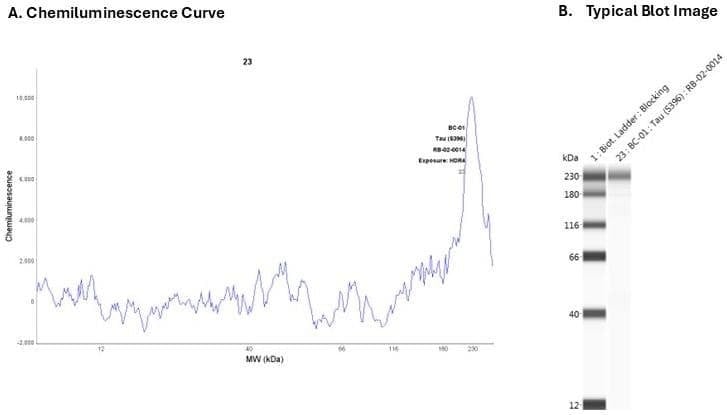
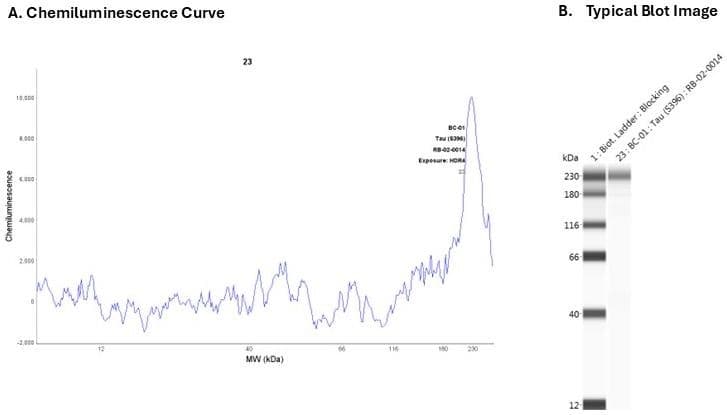
Cell Lysate: BC-01 | Secondary Ab: Rabbit | Exposure: HDR | Expected MW (kDa): 78
Anti-Hyper-Phospho-Tau (pSer396) Antibody
Contact Us for Bulk Request
Product Description
Specifications
| Size | 20 µg, 100 µg, 200 µg, 500 µg |
| Specificity | The antibody specifically detects phosphorylated protein derived from human brain tissue. It recognizes PHF-tau phosphorylated at Ser396.In both ELISA and WB, this antibody shows no cross-reactivity with other unrelated protein. |
| Clonality | Polyclonal |
| Immunogen | Immunogen was synthetic peptide derived from human Tau. This antibody was obtained from a rabbit immunized with the immunogen. The IgG fraction of immunized serum was purified by affinity chromatography. |
| Recommended Applications | ELISA (recommended work dilution= 1: 5, 000-10, 000), Western Blotting (recommended work dilution= 1-5 µg/ml), Immunoprecipitation |
| Reconstitution | Supplied as 150 µl of purified antibody (1 mg/ml) in 10 mM sodium HEPES (pH 7.5),150 mM NaCl, 100 ?g/ml BSA and 50% glycerol. Store at 20°C. Do not aliquot the antibody. |
| Shipping Type | Ambient temperature |
| Storage | -20°C |
Related Products
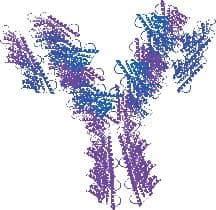
Anti-Hyper-Phospho-Tau (pSer396) Antibody, Biotinylated
$176.00
Description
Microtubule-associated protein, tau is abnormally hyperphosphorylated in the brain of patients with Alzheimer's disease, and is the major protein subunit of paired helical filaments. There is also a significant pool of non-paired helical filament abnormally phosphorylated tau in Alzheimer's disease brain. Tau is a family of six isoforms, derived from a single gene by mRNA splicing. Tau protein is produced by a single gene expressed predominantly in neurons. They vary in size from 352-441 amino acides. In Alzheimer disease Tau is hyperphosphorylated, containing 3-4 fold more phosphoate/mole of the protein than the normal tau. Recent investigations show that MARK and PKA phosphorylate several sites within the repeats (notably the KXGS motifs including Ser262, Ser324, and Ser356, plus Ser320); in addition PKA phosphorylates some sites in the flanking domains, notably Ser214. This type of phosphorylation strongly reduces tau's affinity for microtubules, and at the same time inhibits tau's assembly into PHFs (Paired helical filament).
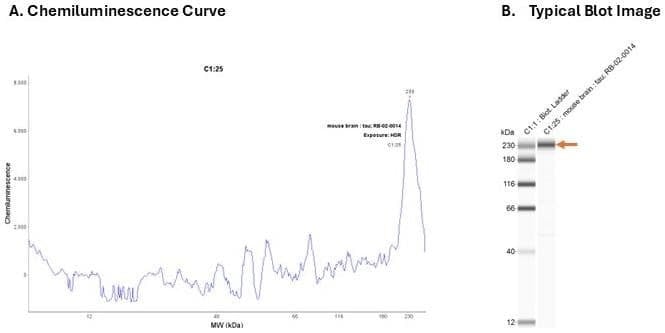
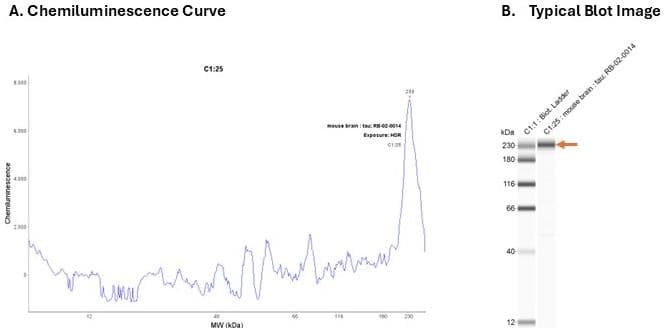
Typical Data
Expiration
12 months from the date of shipment when stored properly.
References
- Arima, K., et al. (2000). NACP/alpha-synuclein and tau constitute two distinctive subsets of filaments in the same neuronal inclusions in brains from a family of parkinsonism and dementia with Lewy bodies: double-immunolabeling fluorescence and electron microscope studies. Acta Neuropathol. 100(2), 115-121.
- Gong CX, Grundke-Iqbal I, Iqbal K(1994).Dephosphorylation of Alzheimer's disease abnormally phosphorylated tau by protein phosphatase-2A.Neuroscience. 61(4):765-72.
- Biernat, J., et al. (1992). The switch of tau protein to an Alzheimer-like state includes the phosphorylation of two serine-proline motifs upstream of the microtubule binding region. EMBO J. 11(4), 1593-1597.