

Mouse R-spondin-1(RSPO1) ELISA kit

Referência CSB-EL020550MO-48T
Tamanho : 48T
Marca : Cusabio
 SDS
SDS| Size | 96T,5×96T,10×96T |
Product Details
Target Name
R-spondin homolog (Xenopus laevis)
Associated names
Rspo1R-spondin-1 ELISA kit; Cysteine-rich and single thrombospondin domain-containing protein 3 ELISA kit; Cristin-3 ELISA kit; mCristin-3 ELISA kit; Roof plate-specific spondin-1 ELISA kit
Abbreviation
Uniprot No.
Species
Mus musculus (Mouse)
Sample Types
serum, plasma, tissue homogenates
Detection Range
6.25 pg/mL-400 pg/mL
Sensitivity
1.56 pg/mL
Assay Time
1-5h
Sample Loading Volume
50-100ul
Detection Wavelength
450 nm
Research Area
Developmental Biology
Assay Principle
quantitative
Measurement
Sandwich
Precision
| Intra-assay Precision (Precision within an assay): CV%<8% | ||||||
| Three samples of known concentration were tested twenty times on one plate to assess. | ||||||
| Inter-assay Precision (Precision between assays): CV%<10% | ||||||
| Three samples of known concentration were tested in twenty assays to assess. | ||||||
Linearity
| To assess the linearity of the assay, samples were spiked with high concentrations of mouse RSPO1 in various matrices and diluted with the Sample Diluent to produce samples with values within the dynamic range of the assay. | ||||||
| Sample | Serum(n=4) | |||||
| 1:1 | Average % | 93 | ||||
| Range % | 86-97 | |||||
| 1:2 | Average % | 101 | ||||
| Range % | 96-105 | |||||
| 1:4 | Average % | 93 | ||||
| Range % | 85-97 | |||||
| 1:8 | Average % | 92 | ||||
| Range % | 84-96 | |||||
Recovery
| The recovery of mouse RSPO1 spiked to levels throughout the range of the assay in various matrices was evaluated. Samples were diluted prior to assay as directed in the Sample Preparation section. | ||||||
| Sample Type | Average % Recovery | Range | ||||
| Serum (n=5) | 90 | 81-94 | ||||
| EDTA plasma (n=4) | 107 | 101-111 | ||||
Typical Data
| These standard curves are provided for demonstration only. A standard curve should be generated for each set of samples assayed. | |||||||||||||||||||||||||||||||||||||||||||||||||||||||||||||||
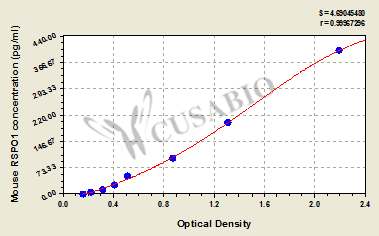
| |||||||||||||||||||||||||||||||||||||||||||||||||||||||||||||||
ELISA Data Analysis
Troubleshooting
and FAQs
and FAQs
Storage
Store at 2-8°C. Please refer to protocol.
Shelf Life
6 months
Description
This Mouse RSPO1 ELISA Kit was designed for the quantitative measurement of Mouse RSPO1 protein in serum, plasma, tissue homogenates. It is a Sandwich ELISA kit, its detection range is 6.25 pg/mL-400 pg/mL and the sensitivity is 1.56 pg/mL.
Customer Reviews and Q&A
There are currently no reviews for this product.
Target Background
Function
(From Uniprot)
(From Uniprot)
Activator of the canonical Wnt signaling pathway by acting as a ligand for LGR4-6 receptors. Upon binding to LGR4-6 (LGR4, LGR5 or LGR6), LGR4-6 associate with phosphorylated LRP6 and frizzled receptors that are activated by extracellular Wnt receptors, triggering the canonical Wnt signaling pathway to increase expression of target genes. Also regulates the canonical Wnt/beta-catenin-dependent pathway and non-canonical Wnt signaling by acting as an inhibitor of ZNRF3, an important regulator of the Wnt signaling pathway. Acts as a ligand for frizzled FZD8 and LRP6. May negatively regulate the T...
Gene References into Functions
- reciprocal control of antagonistic Wnt signaling pathways by Rspo1 in muscle stem cell progeny is a key step ensuring normal tissue architecture restoration following acute damage.
- In Rspo1 knock-out mice during pregnancy, a stronger expression of mesenchymal markers was observed, without modifications to the structure of mammary epithelial tissue. Mammary epithelial cell immunohistochemical analysis revealed a persistence of virgin markers, which signify a delay in cell differentiation.
- We also show that R-spondin1 is depleted in RANK-null progenitors, and that its exogenous administration rescues key aspects of RANK deficiency by reinstating a WNT response and mammary cell expansion
- R-spondin 1/dickkopf-1/beta-catenin machinery is involved in testicular embryonic angiogenesis
- The ascl2 is regulated in a direct autoactivatory loop, leading to a distinct on/off expression pattern, and Wnt/R-spondin can activate this regulatory loop.
- RSPO1, WNT4, and beta-catenin have roles in the signaling pathway during ovarian differentiation in mice.
- Rspo1 is required for ovarian differentiation by activation of the WNT/CTNNB1 signalling pathway
- Rspo1 is involved in maintenance of the immature state of the progenitors of the granulosa cells of the ovary
- Rspo1 is involved in the progenitor cells proliferation of the coelomic epithelium of the undifferentiated gonad of the mouse embryo
- ZNRF3 binds RSPO1 and LGR5-RSPO1 with micromolar affinity via RSPO1 furin-like 1 (Fu1) domain.
- overexpressed in culture-activated hepatic stellate cells
- R-spondin1 (Rspo1) as a novel hormonal mediator in the mammary gland
- Findings indicate that R-spondin1 (Rspo1) is a negative regulator of beta-cell neogenesis and suggest that Rspo1 may serve as a therapeutic target for the preservation or restoration of functional [beta]-cells in diabetes.
- R-Spondin 1 is upregulated by mechanical signals and secreted. R-Spondin 1 promotes bone formation in three mouse models of osteoporosis.
- Wnt/Rspondin/beta-catenin signals control axonal sorting and lineage progression in Schwann cell development.
- In conclusion, present study highlights the role of Rspo 1 in bone remodeling where it activates Wnt signaling to induce differentiation, as shown in human as well murine in vitro osteoblast cell models.
- Rspo1 is an essential activator of ovarian development not only in normal situations, but also in sex reversal situations
- this study identifies Rspo1 and Wnt4 as two new regulators of cell proliferation in the early gonad regardless of its sex, in addition to the specific role of these genes in ovarian differentiation.
- Foxl2 expression partly depends of Rspo1 signalisation.
- RSPO1/beta-catenin signaling is involved in meiosis in fetal germ cells and contributes to the cellular decision of germ cells to differentiate into oocyte or sperm.
- The study reveals a role for RSPO1 as a regulator of both beta cell proliferation and neogenesis in vivo, and reinforces the importance of cWNT signalling for the maintenance of normal pancreatic beta cell behaviour.
- The Wnt agonist R-spondin1 regulates systemic graft-versus-host disease by protecting intestinal stem cells.
- R-spondin-1 is a novel beta-cell growth factor and insulin secretagogue
- Intestinal ischemia-reperfusion injury may inhibit expression of RSpo1 in the early stage, and enhance its expression in the middle stage.
- R-spondin1, an intestinal stem cell growth factor, protects against radiation-induced gastrointestinal syndrome in mice
- R-spondin might be a novel marker of the boundary between the roof plate and neuroepithelium and may contribute to the development of dorsal neural tube under the regulation of Wnts.
- R-sponin1 (Rspo1) acted synergistically with Wnt3A to activate Wnt/beta-catenin signaling in the uncommitted mesenchymal C2C12 cells.
- Rspo1 is required to fully suppress the male differentiation program and to maintain germ cell survival during the development of XX gonads.
- Balance between Sox9 and beta-catenin activation determines the fate of the gonad, with Rspo1 acting as a crucial regulator of canonical beta-catenin signaling required for female development.
- RSPO1 is up-regulated in the embryonic gonads of female vertebrates with different sex-determining mechanisms.
- R-Spondin1 protects mice from chemotherapy or radiation-induced oral mucositis through the canonical Wnt/beta-catenin pathway
- SRY represses the transcriptional of the Rspo1/Wnt target genes involved in ovarian determination.
- these data demonstrate that local epithelial Rspo1 signalling is required for normal development of the mammary gland.
Subcellular Location
Secreted. Nucleus.
Protein Families
R-spondin family
Tissue Specificity
Expressed in the dorsal part of the neural tube on 10 and 12 dpc, especially in the boundary region between roof plate and neuroepithelium. This expression is enhanced in the rostral part. Also expressed in other tissues such as truncal region neighboring
Database Links
KEGG:
STRING:
UniGene: