


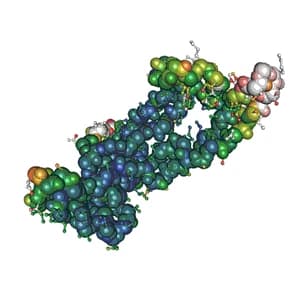
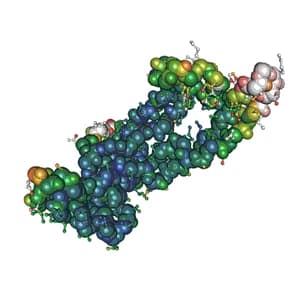
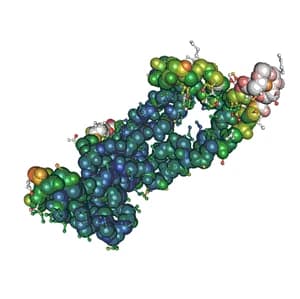
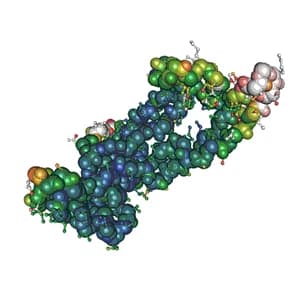
Recombinant SARS-CoV-2, S1 Subunit Protein (RBD) with C-terminal His tag, derived from the transfected human HEK293 cells.
Best Seller
Recombinant SARS-CoV-2, S1 Subunit Protein (RBD)
Recombinant SARS-CoV-2, S1 Subunit Protein (RBD)
Contact Us for Bulk Request
Product Description
Specifications
| Size | 100 µg, 500 µg, 1000 µg |
| Species | SARS-CoV-2 |
| Accession Number | QHD43416 |
| Protein Name / Synonyms | Spike protein, S Protein, S1 Subunit, Host Cell Receptor Binding Domain (RBD) |
| Expressed Region | Arg319-Phe541 |
| Expression System | HEK293 cells |
| Tag | C-terminal his-tag |
| Purity | >95 % |
| Purity Determined By | SDS-PAGE under reducing conditions and visualized by Coomassie blue staining |
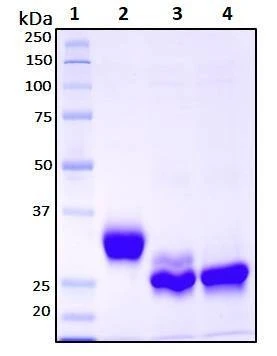
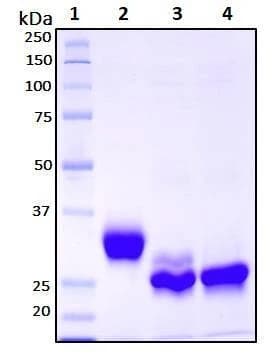
| Molecular Weight (kDa) | Recombinant protein product has a calculated molecular mass of 25 kDa. Due to the abundant glycosylation, it migrates as approximately 30 kDa protein bands in SDS-PAGE under DTT, beta-mercaptoethanol reducing conditions. See deglycosylation analysis image below. |
| Format | Liquid |
| Formulation | Supplied as a 0.2 µm filtered solution in PBS (pH 7.4) |
| Concentration (lot specific) | Lot specific (see the label on the vial), determined by BCA protein assay |
| Research Area | Antibody Drug Development, Receptor-Ligand Binding, Infectious Disease, COVID-19 |
| Shipping Type | Blue ice |
| Storage | -20°C |
Related Products
Recombinant SARS-CoV-2, S1 Subunit Protein (RBD), Biotinylated
As low as $400.00
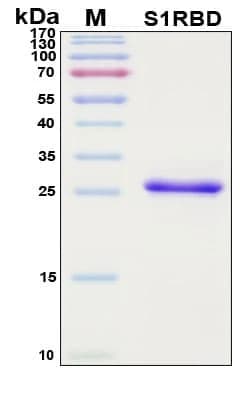
Recombinant SARS-CoV-2 Spike Protein, S1 Subunit, Host Cell Receptor Binding Domain (RBD), Antigen Grade
As low as $256.00
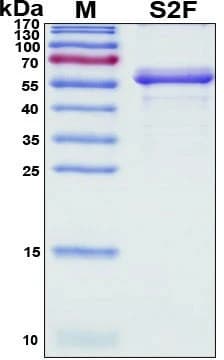
Recombinant SARS-CoV-2 Spike Protein, S2 Subunit
As low as $256.00
SDS-PAGE Image
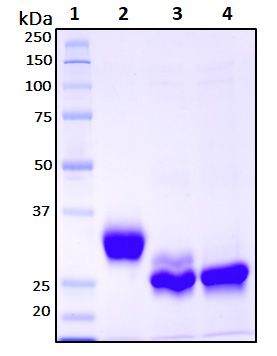
Lane 1: Protein standard ladder (kDa)
Lane 2: Untreated protein under reducing conditions
Lane 3: Treated protein with deglycosylation enzymes under native conditions
Lane 4: Treated protein with deglycosylation enzymes under reducing conditions.
Binding Function
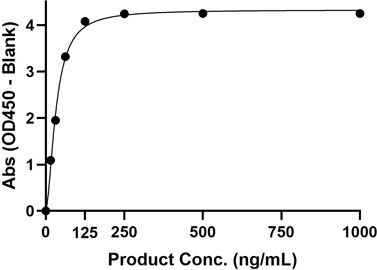
Activity
Storage/Stability
Upon arrival, the protein may be stored for 2 weeks at 4°C. For long term storage, it is recommended to store at -20°C or -80°C in appropriate aliquots. Avoid repeated freeze-thaw cycles.
Introduction
SARS-CoV-2, the virus responsible for COVID-19, uses its spike protein to enter host cells, with the receptor-binding domain (RBD) playing a central role in this process. The RBD within the S1 subunit specifically binds to the angiotensin-converting enzyme 2 (ACE2) receptor on human cells, facilitating viral entry and subsequent infection. This domain is a key target for neutralizing antibodies and vaccine design.
Reference: https://link.springer.com/chapter/10.1007/978-3-031-46545-1_13
Typical Data
Custom Labeling Request
We can custom label this protein with biotin or fluorescent dyes (choose from violet, blue, green or red). Request now.
citations
Hybrid immunity from bivalent vaccination and prior infection enhances humoral and innate protection against Omicron XBB.1.16 and EG.5.1.1 variants in Japan
- Species:
- Human
- Sample Type:
- Other / Unspecified (monocyte-derived macrophages)
- Year:
- 2026
- Journal Name:
- Frontiers in Immunology
- PubMed ID:
- 42465771
T-cell-derived IFN-γ suppresses T follicular helper cell differentiation and antibody responses
- Species:
- Mouse
- Sample Type:
- Serum (mice immunized with RBD)
- Year:
- 2025
- Journal Name:
- EMBO Journal
- PubMed ID:
- 40169810
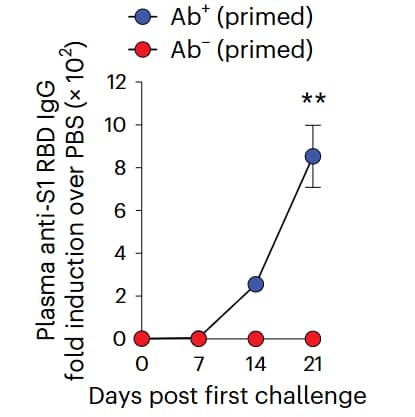
Antibody-independent protection against heterologous SARS-CoV-2 challenge conferred by prior infection or vaccination
- Year:
- 2024
- Journal Name:
- Nature Immunology
- PubMed ID:
- 38486021
A Paper-Based Multiplexed Serological Test to Monitor Immunity against SARS-COV-2 Using Machine Learning
- Year:
- 2024
- Journal Name:
- Acs Nano
- PubMed ID:
- 38888985
Contralateral second dose improves antibody responses to a 2-dose mRNA vaccination regimen
- Year:
- 2024
- Journal Name:
- Journal of Clinical Investigation
- PubMed ID:
- 38227381
In Vivo Iterative Adjuvant Screening Identifies an Intranasal Vaccine Formulation for Elicitation of Protective Mucosal Immune Responses Against SARS-CoV-2
- Species:
- Mouse
- Sample Type:
- Serum (vaccine antigen for immunized mice, ELISA coating antigen for mouse sera); Tissue Lysate / Homogenate (lung homogenates)
- Year:
- 2025
- Journal Name:
- Pharmaceutics
- PubMed ID:
- 41304760
SARS-CoV-2 Protein Nanoparticle Vaccines Formed In Situ From Lyophilized Lipids
- Year:
- 2024
- Journal Name:
- Small
- PubMed ID:
- 37849036
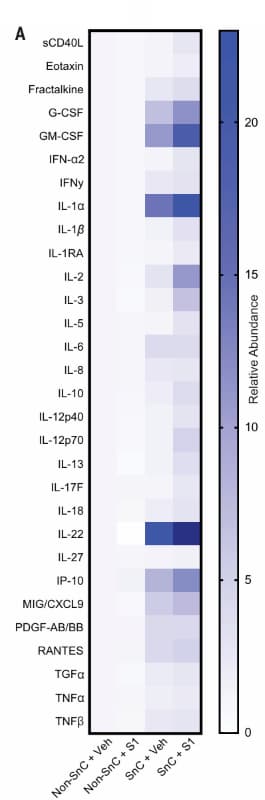
SARS-CoV-2 Spike Protein Stimulates Macropinocytosis in Murine and Human Macrophages via PKC-NADPH Oxidase Signaling
- Species:
- Mouse
- Sample Type:
- Other / Unspecified (human macrophages)
- Year:
- 2024
- Journal Name:
- Antioxidants
- PubMed ID:
- 38397773
The SpACE-CCM: A facile and versatile cell culture medium-based biosensor for detection of SARS-CoV-2 spike-ACE2 interaction
- Year:
- 2023
- Journal Name:
- Biosensors & Bioelectronics
- PubMed ID:
- 36827795
CuBe: a geminivirus-based copper-regulated expression system suitable for post-harvest activation
- Species:
- Other
- Sample Type:
- Other Body Fluid (total protein or apoplastic fluid samples)
- Year:
- 2025
- Journal Name:
- Plant biotechnology journal
- PubMed ID:
- 39435699