

Anti-Phospho-ERK1/2 (Thr183, Tyr185) Polyclonal Antibody

Cat# NB-64-113980-50uL
Size : 50uL
Brand : Neo Biotech
Remove All
Anti-Phospho-ERK1/2 (Thr183, Tyr185) Polyclonal Antibody
(Synonyms: Prkm3, p44mapk, p44erk1, p44, Mtap2k, Mnk1, Esrk1, Ert2, Erk-1, Erk1) Copy Product InfoSynonyms: Prkm3, p44mapk, p44erk1, p44, Mtap2k, Mnk1, Esrk1, Ert2, Erk-1, Erk1
Catalog No. TMAB-01408 Copy Product Info
Anti-Phospho-ERK1/2 (Thr183, Tyr185) Polyclonal Antibody is a Rabbit antibody targeting Phospho-ERK1/2 (Thr183, Tyr185). Anti-Phospho-ERK1/2 (Thr183, Tyr185) Polyclonal Antibody can be used in ICC/IF.
For research use only—not for human use. No sales to individuals. Use as intended only.
Product Information
Bioactivity
Antigen Details
Chemical Properties
Stability & Storage
| Description | Anti-Phospho-ERK1/2 (Thr183, Tyr185) Polyclonal Antibody is a Rabbit antibody targeting Phospho-ERK1/2 (Thr183, Tyr185). Anti-Phospho-ERK1/2 (Thr183, Tyr185) Polyclonal Antibody can be used in ICC/IF. |
| Synonyms | Prkm3, p44mapk, p44erk1, p44, Mtap2k, Mnk1, Esrk1, Ert2, Erk-1, Erk1 |
| Ig Type | IgG |
| Reactivity | Human (predicted:Mouse,Rat,Chicken,Dog,Cow,Horse,Rabbit,GuineaPig) |
| Verified Activity | 1. Tissue/cell: Hela cell; 4% Paraformaldehyde-fixed; Triton X-100 at room temperature for 20 min; Blocking buffer (normal goat serum) at 37°C for 20 min; Antibody incubation with (phospho-ERK1 + 2 (Thr183/Tyr185)) polyclonal Antibody, Unconjugated (TMAB-01408) 1:100, 90 minutes at 37°C; followed by a FITC conjugated Goat Anti-Rabbit IgG antibody at 37°C for 90 minutes, DAPI (blue) was used to stain the cell nucleus. 2. Tissue/cell: HUVEC cell; 4% Paraformaldehyde-fixed; Triton X-100 at room temperature for 20 min; Blocking buffer (normal goat serum) at 37°C for 20 min; Antibody incubation with (phospho-ERK1 + 2 (Thr183/Tyr185)) Polyclonal Antibody, Unconjugated (TMAB-01408) 1:100, 90 minutes at 37°C; followed by a conjugated Goat Anti-Rabbit IgG antibody at 37°C for 90 minutes, DAPI (blue) was used to stain the cell nucleus. 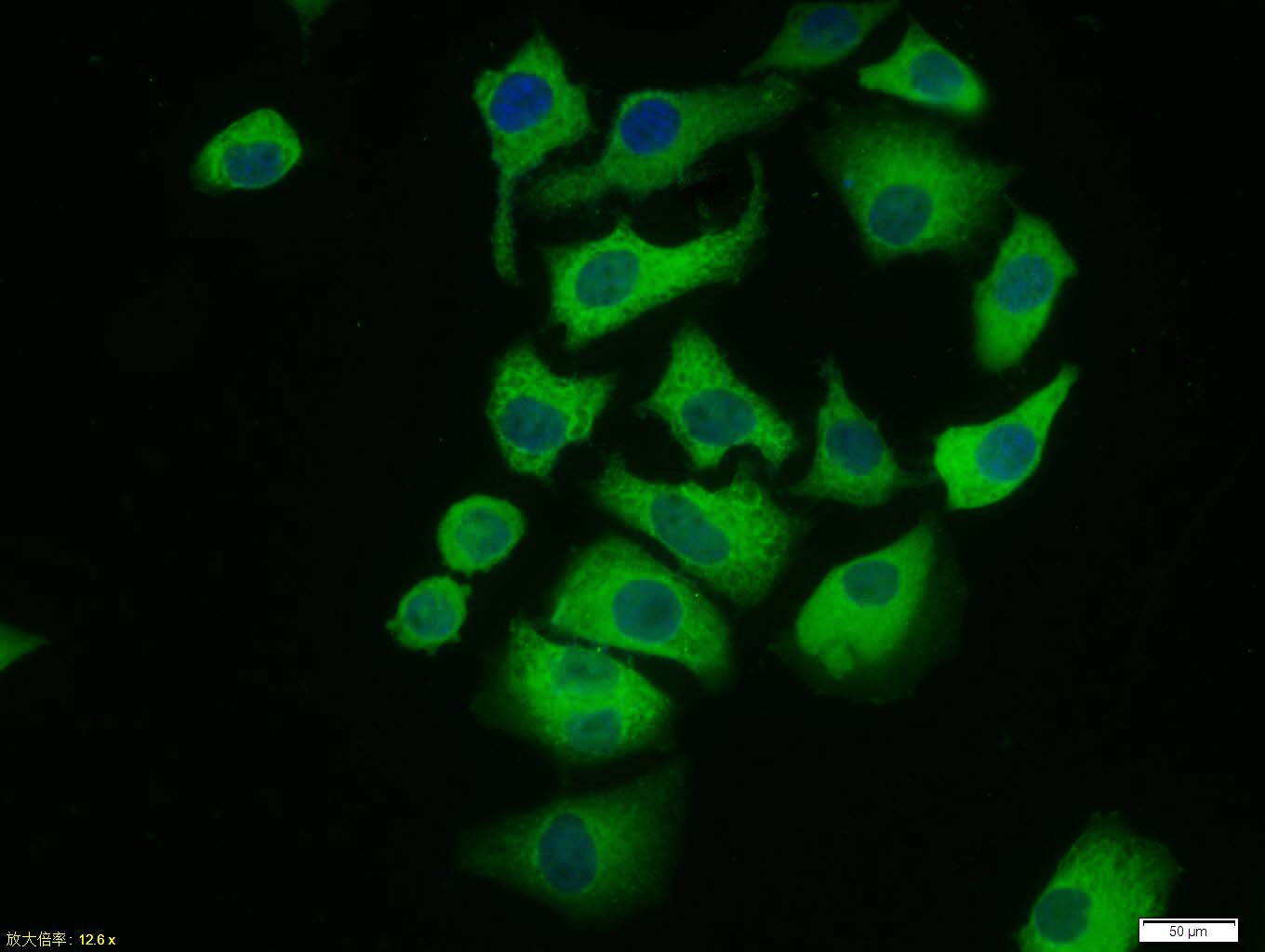 , ,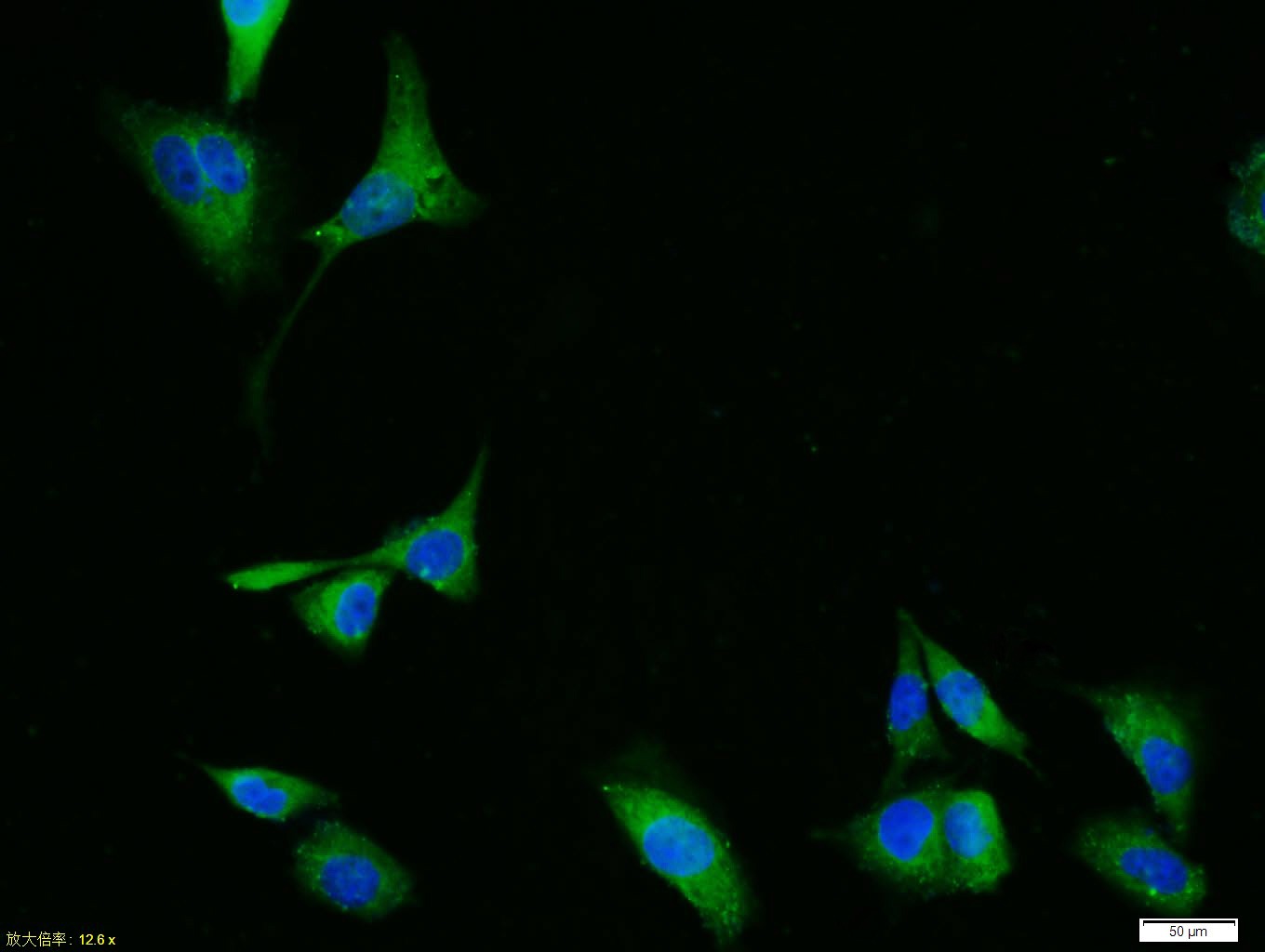 |
| Application | ICC/IF |
| Recommended Dose | ICC/IF=1:50-200 |
| Antibody Type | Polyclonal |
| Host Species | Rabbit |
| Subcellular Localization | Cytoplasm, cytoskeleton, spindle. Nucleus. Cytoplasm, cytoskeleton, centrosome. Cytoplasm. Note=Associated with the spindle duringprometaphase and metaphase. PEA15-binding andphosphorylated DAPK1 promote its cytoplasmic retention.Phosphorylation at Ser-244 and Ser-246 as well asautophosphorylation at Thr-188 promote nuclear localization. |
| Tissue Specificity | Widely expressed. |
| Construction | Polyclonal Antibody |
| Purification | Protein A purified |
| Appearance | Liquid |
| Formulation | 0.01M TBS (pH7.4) with 1% BSA, 0.02% Proclin300 and 50% Glycerol. |
| Concentration | 1 mg/mL |
| Research Background | Enables MAP kinase activity and phosphotyrosine residue binding activity. Involved in several processes, including cell surface receptor protein tyrosine kinase signaling pathway; nervous system development; and regulation of DNA-binding transcription factor activity. Acts upstream of or within several processes, including Bergmann glial cell differentiation; ERK1 and ERK2 cascade; and respiratory system development. Located in cytosol; nucleus; and pseudopodium. Is active in glutamatergic synapse. Is expressed in several structures, including alimentary system; early conceptus; genitourinary system; nervous system; and sensory organ. Human ortholog(s) of this gene implicated in Parkinson's disease; carcinoma (multiple); and pulmonary hypertension. Orthologous to human MAPK3 (mitogen-activated protein kinase 3). [provided by Alliance of Genome Resources, Apr 2025] |
| Immunogen | KLH conjugated Synthesised phosphopeptide: mouse ERK1 around the phosphorylation site of Thr183/Tyr185 |
| Antigen Species | Mouse |
| Gene Name | Mapk3 |
| Gene ID | 26417 |
| Protein Name | Mitogen-activated protein kinase 3 |
| Biology Area | Tangles & Tau,MAPK Pathway,Cytoplasmic |
| Function | Serine/threonine kinase which acts as an essentialcomponent of the MAP kinase signal transduction pathway. MAPK1/ERK2and MAPK3/ERK1 are the 2 MAPKs which play an important role in theMAPK/ERK cascade. They participate also in a signaling cascadeinitiated by activated KIT and KITLG/SCF. Depending on the cellularcontext, the MAPK/ERK cascade mediates diverse biological functionssuch as cell growth, adhesion, survival and differentiation throughthe regulation of transcription, translation, cytoskeletalrearrangements. The MAPK/ERK cascade plays also a role ininitiation and regulation of meiosis, mitosis, and postmitoticfunctions in differentiated cells by phosphorylating a number oftranscription factors. About 160 substrates have already beendiscovered for ERKs. Many of these substrates are localized in thenucleus, and seem to participate in the regulation of transcriptionupon stimulation. However, other substrates are found in thecytosol as well as in other cellular organelles, and those areresponsible for processes such as translation, mitosis andapoptosis. Moreover, the MAPK/ERK cascade is also involved in theregulation of the endosomal dynamics, including lysosome processingand endosome cycling through the perinuclear recycling compartment(PNRC); as well as in the fragmentation of the Golgi apparatusduring mitosis. The substrates include transcription factors (suchas ATF2, BCL6, ELK1, ERF, FOS, HSF4 or SPZ1), cytoskeletal elements(such as CANX, CTTN, GJA1, MAP2, MAPT, PXN, SORBS3 or STMN1),regulators of apoptosis (such as BAD, BTG2, CASP9, DAPK1, IER3,MCL1 or PPARG), regulators of translation (such as EIF4EBP1) and avariety of other signaling-related molecules (like ARHGEF2, DCC,FRS2 or GRB10). Protein kinases (such as RAF1, RPS6KA1/RSK1,RPS6KA3/RSK2, RPS6KA2/RSK3, RPS6KA6/RSK4, SYK, MKNK1/MNK1,MKNK2/MNK2, RPS6KA5/MSK1, RPS6KA4/MSK2, MAPKAPK3 or MAPKAPK5) andphosphatases (such as DUSP1, DUSP4, DUSP6 or DUSP16) are othersubstrates which enable the propagation the MAPK/ERK signal toadditional cytosolic and nuclear targets, thereby extending thespecificity of the cascade. Mediates phosphorylation of TPR inrespons to EGF stimulation. May play a role in the spindle assemblycheckpoint. Phosphorylates PML and promotes its interaction withPIN1, leading to PML degradation (By similarity). Acts as a transcriptional repressor. Binds to a[GC]AAA[GC] consensus sequence. Repress the expression ofinterferon gamma-induced genes. Seems to bind to the promoter ofCCL5, DMP1, IFIH1, IFITM1, IRF7, IRF9, LAMP3, OAS1, OAS2, OAS3 andSTAT1. Transcriptional activity is independent of kinase activity. |
| Molecular Weight | Theoretical: 42/44 kDa. |
| Stability & Storage | Store at -20°C or -80°C for 12 months. Avoid repeated freeze-thaw cycles. |
| Transport | Shipping with blue ice. |
Calculator
Preview
Related Tags: Anti-Phospho-ERK1/2 (Thr183, Tyr185) Polyclonal Antibody molecular weight
Generate Quote
Catalog No.: Cas No.:
Add
| Size | Quantity | Unit Price | Amount | Operation |
|---|
Generate Quote