EPCAM Antibody: Azide Free

Cat# OASA01900
Size : 1mg
Brand : Aviva Systems Biology
EPCAM Antibody: Azide Free (OASA01900)

| Datasheets/Manuals | Printable datasheet for EPCAM Antibody: Azide Free (OASA01900) |
|---|
| Predicted Species Reactivity | Human |
|---|---|
| Product Format | Liquid. Phosphate buffered saline |
| Clonality | Monoclonal |
| Clone | MOC-31 |
| Isotype | IgG1 |
| Host | Mouse |
| Conjugation | AF: Azide Free |
| Application | FC|IHC-Fr|IHC-P |
| Additional Information | Histology Positive Control Tissue: Lung carcinoma |
| :: | Preservative Stabilisers: None Present |
| :: | Approx Protein Conc: IgG concentration 0.5 mg/ml Buffer Solutions: Phosphate buffered saline |
| Reconstitution and Storage | -20°C |
| Purification | Antibody purified from tissue culture supernatant |
| Predicted Homology Based on Immunogen Sequence | Human |
| Concentration | 0.5 mg/ml |
| Specificity | This antibody recognises the 40kDa cell surface antigen known as CD326. This antigen has been identified independently by a number of groups, and it has been known by a variety of names including Epithelial Cell Adhesion Molecule (Ep-CAM), Epithelial Specific Antigen, MOC31 and Ber-EP4. Several monoclonal antibodies have been raised against CD326, many of which have been described as tumour specific molecules on carcinomas. CD326 is a Type 1 transmembrane glycoprotein. It is expressed on the basolateral membrane of cells by the majority of epithelial tissues, with the exception of adult squamous epithelium and some specific epithelial cell types including hepatocytes and gastric epithelial cells. CD326 expression has been reported to be a possible marker of early malignancy, with expression being increased in tumour cells, and de novo expression being seen in dysplastic squamous epithelium. |
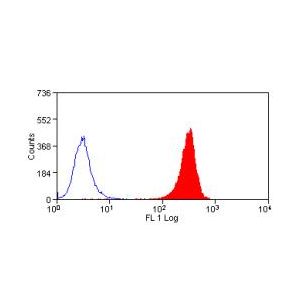
| Application Info | Flow Cytometry: 10ug/ml Use 10ul of the suggested working dilution to label 106 cells in 100ul. Immunohistology - Frozen: 10ug/ml (This product requires antigen retrieval using heat treatment prior to staining of paraffin sections.Sodium citrate buffer pH 6.0 is recommended for this purpose. - Flow Cytometry : Use 10ul of the suggested working dilution to label 106 cells in 100ul. |
| Reference | 1. Souhami, R. L. et al. (1987) Antigens of small cell lung cancer. First International Workshop. Lancet. 2: 325-326. 2. Winter, M. J. et al. (2003) The epithelial cell adhesion molecule (Ep-CAM) as a morphoregulatory molecule is a tool in surgical pathology. Am. J. Pathol. 163: 2139-2148. |
|---|---|
| Gene Symbol | EPCAM |
| Alias Symbols | adenocarcinoma-associated antigen, cell surface glycoprotein Trop-1, DIAR5, EGP-2, EGP314, EGP40, epithelial cell adhesion molecule, epithelial glycoprotein 314, ESA, HNPCC8, human epithelial glycoprotein-2, KS1/4, KSA, M4S1, major gastrointestinal tumor-associated protein GA733-2, membrane component, chromosome 4, surface marker (35kD glycoprotein), MIC18, MK-1, TACSTD1, TROP1, trophoblast cell surface antigen 1, tumor-associated calcium signal transducer 1. |
| NCBI Gene Id | 4072 |
| Protein Name | Epithelial cell adhesion molecule |
| Description of Target | MOUSE ANTI HUMAN CD326:Azide Free |
| Uniprot ID | P16422 |
| Protein Accession # | NP_002345.2 |
| Protein Size (# AA) | 314 |