

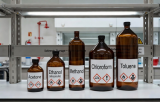
Laboratory solvents are fundamental components in biochemical and molecular research. They are used for dissolving chemical reagents, extracting target analytes, and supporting various reaction environments required in lipid analysis, protein assays, and metabolic studies.
Solvent Classifications
Laboratory solvents are generally classified based on polarity and molecular structure into three main groups: polar protic solvents (such as water, methanol, and ethanol), polar aprotic solvents (such as dimethyl sulfoxide (DMSO), acetonitrile, and dimethylformamide (DMF)), and non-polar solvents (such as hexane, toluene, and chloroform).
Polar protic solvents contain hydrogen-bonding functional groups like O–H or N–H, enabling efficient ion stabilization and proton transfer reactions, which are particularly useful in enzymatic assays. Non-polar solvents are mainly applied to dissolve hydrophobic biomolecules such as lipids and membrane-associated proteins. Aprotic solvents are widely used in chromatographic separation and buffer exchange processes due to their low nucleophilic reactivity.
Biochemical Applications
In lipid biochemistry, chloroform–methanol mixtures (2:1, v/v) are commonly used for phospholipid extraction from biological cells following the Folch partitioning method, enabling phase separation for glycolipid characterization.
In molecular biology workflows, ethanol is frequently employed to precipitate nucleic acids during next-generation sequencing library preparation. Acetonitrile-based gradients are widely used in high-performance liquid chromatography (HPLC) for the purification of peptides, carbohydrates, and small metabolites.
Dimethyl sulfoxide (DMSO) is widely used to solubilize hydrophobic compounds in metabolomic pathway investigations, while diethyl ether is sometimes applied in viral particle isolation procedures due to its ability to remove lipid envelopes without significantly denaturing biological macromolecules.
























