

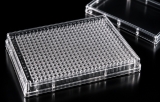
The 384-well plate is a high-density multiwell format designed for high-throughput cell culture and screening applications. It offers a substantial increase in sample capacity compared with lower-density plates such as 6-, 12-, 24-, 48-, and 96-well formats, while reducing reagent consumption and space requirements. Typical working volumes are on the order of 10 to 100 µL per well, with a growth surface area of approximately 0.056 cm², making the format suitable for miniaturized assays, compound libraries, and large-scale experimental designs. The 384-well plate is widely used in drug discovery, genomics, proteomics, and functional cell-based screening.
Materials and Manufacturing
384-well plates are generally manufactured from optical-grade polystyrene, selected for its clarity, chemical inertness, and compatibility with biological systems. The polymer conforms to established biocompatibility standards suitable for direct contact with cells and culture media. Its optical properties permit reliable microscopic observation and detection in plate readers, while mechanical stability supports routine handling, incubation, and centrifugation. Manufacturing is controlled to ensure consistent well geometry, surface uniformity, and low levels of extractable substances. Some variants incorporate glass bottoms or specialized substrates for high-resolution imaging.
Surface Treatments
Surface chemistry strongly influences cell behavior in 384-well plates. Non-treated plates retain a hydrophobic surface that minimizes protein adsorption and cell attachment, making them suitable for suspension cultures. Tissue-culture-treated plates undergo physical or chemical modification that introduces hydrophilic functional groups, promoting serum-protein adsorption and integrin-mediated adhesion of common adherent cell lines. Advanced superhydrophilic treatments further improve attachment and growth of fastidious cells, primary cells, and transfection cell lines, particularly under low-serum or serum-free conditions. The choice of surface treatment is critical for maintaining cell viability and assay performance in miniaturized formats.
