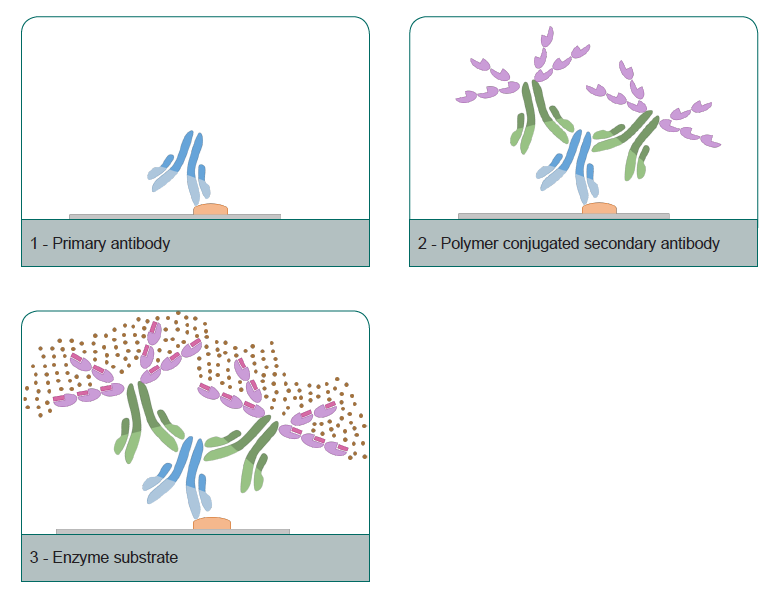
One-step immunohistochemistry (IHC) polymer-based detection kits are advanced methods that use polymers conjugated with enzymes directly linked to secondary antibodies. This method replaces traditional biotin-avidin systems, facilitating a simplified and faster detection process while enhancing sensitivity and reducing background staining.
Detection Mechanism
-
The technique employs polymers such as dextran backbones or smaller linear micro-polymers conjugated with multiple secondary antibodies and enzyme molecules (commonly horseradish peroxidase, HRP).
-
The polymers allow signal amplification by carrying a high enzyme load to the antigen site.
-
Chromogenic substrates (e.g., DAB) are converted by the enzyme to produce visible staining of the antigen.
-
The one-step protocol eliminates the biotin step, reducing nonspecific background in biotin-rich tissues.
Technical Advantages
-
Increased sensitivity due to multiple enzymes per secondary antibody, amplifying the signal for low-abundance proteins.
-
Faster protocols with fewer incubation steps compared to avidin-biotin complex (ABC) or multi-step methods.
-
Reduced background staining by avoiding endogenous biotin detection.
-
Small linear polymers improve tissue penetration and antigen accessibility, particularly for nuclear targets.
-
Suitable for multiplex staining, allowing simultaneous detection of multiple antigens on a single specimen.
Practical Considerations
-
Polymer size impacts tissue penetration; smaller micro-polymers enable access to dense tissue regions.
-
Polymer-based detection kits are generally more expensive but offer high reproducibility and ease of use.
-
These kits are compatible with manual and automated IHC platforms