

Thyroid hormone
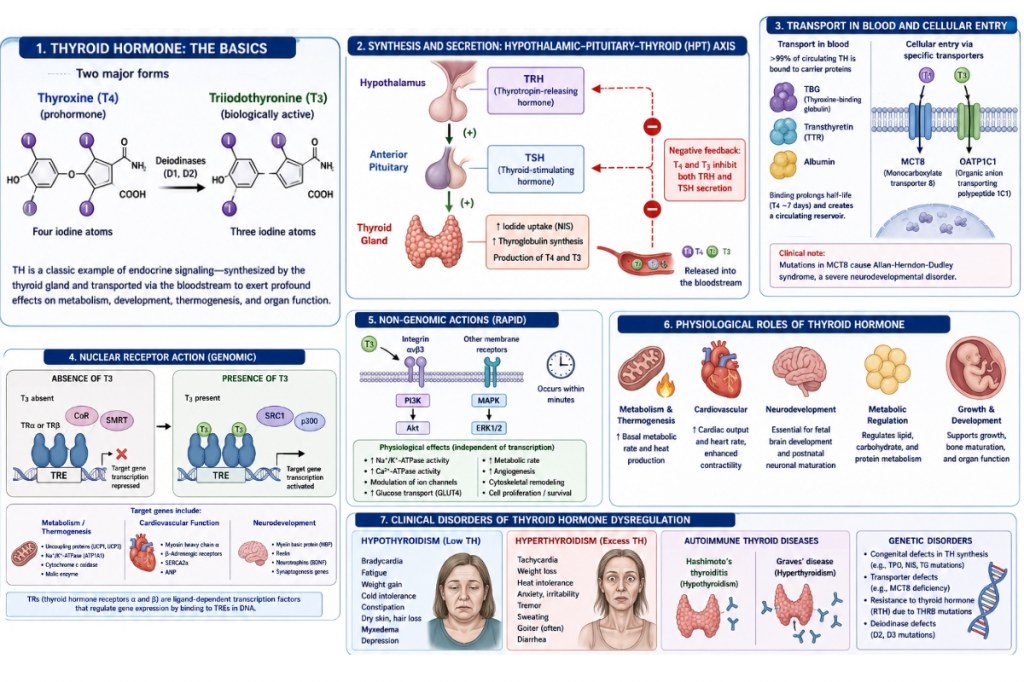
Thyroid hormone (TH) is a classic example of endocrine signaling, synthesized by the thyroid gland and transported via the bloodstream to exert profound effects on metabolism, development, thermogenesis, and organ function. The two major forms are thyroxine (T4, containing four iodine atoms) and the biologically active triiodothyronine (T3), with T4 serving primarily as a prohormone that is deiodinated to T3 in target tissues (Mullur et al., 2014).
Synthesis and secretion
Thyrotropin-releasing hormone (TRH) from the hypothalamus stimulates pituitary secretion of thyroid-stimulating hormone (TSH), which in turn promotes thyroid follicular cell uptake of iodide, thyroglobulin synthesis, and production of T4 and T3. This hypothalamic-pituitary-thyroid axis is regulated by classical negative feedback: T4 and T3 inhibit both TRH and TSH secretion (Chiamolera & Wondisford, 2009).
Transport and cellular entry
More than 99% of circulating TH is bound to carrier proteins—thyroxine-binding globulin (TBG), transthyretin, and albumin—which prolong its half-life and create a reservoir. Free TH enters target cells via specific transmembrane transporters, including MCT8 (monocarboxylate transporter 8) and OATP1C1 (organic anion transporting polypeptide 1C1). Mutations in MCT8 cause Allan-Herndon-Dudley syndrome, a severe neurodevelopmental disorder (Visser et al., 2008).
Nuclear receptor action
T3 exerts most of its effects by binding to thyroid hormone receptors (TRα and TRβ), which are ligand-dependent transcription factors located in the cell nucleus. In the absence of T3, TRs bind to thyroid hormone response elements (TREs) in complex with co-repressors (e.g., NCoR, SMRT), repressing target gene transcription. T3 binding induces a conformational change, displaces co-repressors, and recruits co-activators (e.g., SRC1, p300), thereby activating gene expression (Brent, 2012). Target genes include those involved in basal metabolic rate (e.g., uncoupling proteins, ATPase subunits), cardiac contractility (myosin heavy chain α, β-adrenergic receptors), and neurodevelopment (myelin basic protein, reelin).
Non-genomic actions
In addition to nuclear signaling, T3 rapidly triggers non-genomic effects via integrin αvβ3 and other membrane-associated receptors, activating PI3K/Akt and MAPK pathways within minutes. These actions influence ion channel activity (Na⁺/K⁺-ATPase, Ca²⁺-ATPase), glucose transport, and angiogenesis, independent of transcription (Davis et al., 2016).
Physiological roles and clinical disorders
Thyroid hormone increases basal metabolic rate, stimulates heat production (thermogenesis), enhances cardiac output and heart rate, promotes fetal and postnatal brain development, and regulates lipid and carbohydrate metabolism. Hypothyroidism (low TH) causes bradycardia, fatigue, weight gain, cold intolerance, and myxedema. Hyperthyroidism (excess TH) presents with tachycardia, weight loss, heat intolerance, anxiety, and tremor. Autoimmune diseases—Hashimoto’s thyroiditis (hypothyroidism) and Graves’ disease (hyperthyroidism)—are common. Genetic defects in TH synthesis, transport, or receptor action (e.g., resistance to thyroid hormone due to THRB mutations) highlight the precision required in TH signaling.
|
|
Références
Brent, G. A. (2012). Mechanisms of thyroid hormone action. Journal of Clinical Investigation, 122(9), 3035–3043.
Chiamolera, M. I., & Wondisford, F. E. (2009). Minireview: Thyrotropin-releasing hormone and the thyroid hormone feedback mechanism. Endocrinology, 150(3), 1091–1096.
Davis, P. J., Goglia, F., & Leonard, J. L. (2016). Nongenomic actions of thyroid hormone. Nature Reviews Endocrinology, 12(2), 111–121.
Mullur, R., Liu, Y. Y., & Brent, G. A. (2014). Thyroid hormone regulation of metabolism. Physiological Reviews, 94(2), 355–382.
Visser, W. E., Friesema, E. C., & Visser, T. J. (2008). Transporters and thyroid hormone metabolism. Molecular and Cellular Endocrinology, 293(1-2), 5–12.