


RayBio® Human/Mouse/Rat PYY EIA Kit optimized for serum and cell culture supernatants. Competition-based ELISA on a 96-well strip plate.
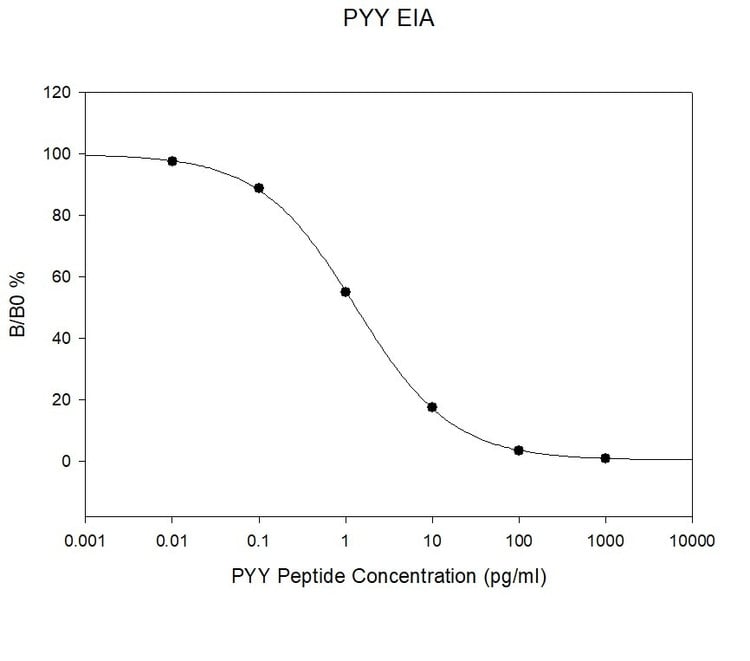
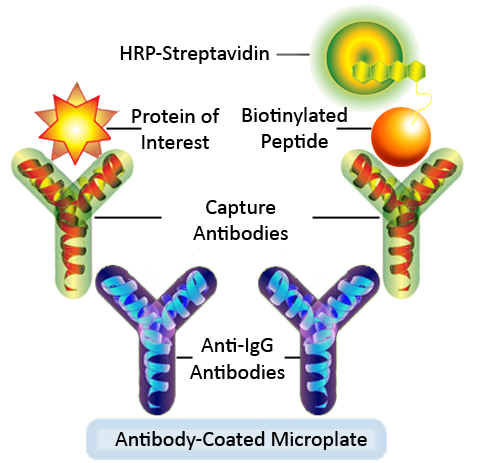

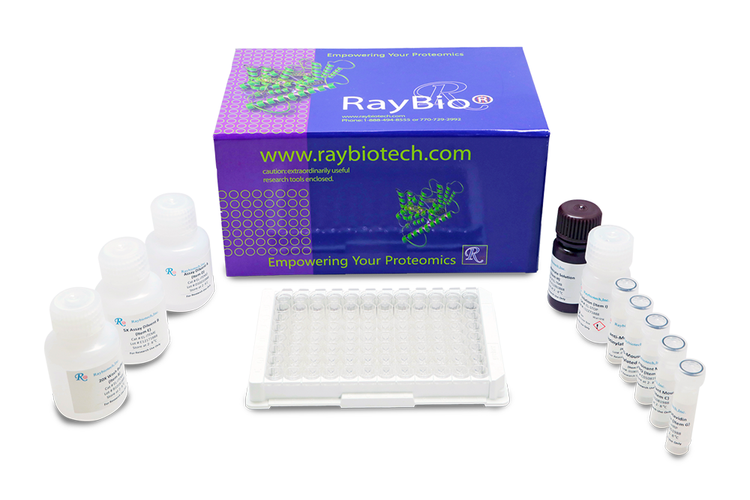
PYY ELISA Kit
PYY ELISA Kit
Contact Us for Bulk Request
Product Description
Specifications
| Size | 1 Plate Kit, 2 Plate Kit, 5 Plate Kit |
| Species | Human, Mouse, Rat |
| Sensitivity | 5.6 pg/ml |
| Detection Range | 0.1-1,000 pg/ml |
| Specificity | Cross Reactivity: This EIA kit shows no cross-reactivity with any of the cytokines tested: Ghrelin, Nesfatin, Angiotensin II, NPY and APC. This kit detects the 1-36 form PYY. |
| Compatible Sample Types | Plasma, Serum |
| Recommended Dilution (Serum/Plasma) | Human: 2x / Mouse: 2x / Rat: 2x |
| Accession Number | P10082 |
| Gene Id | 5697 |
| Gene Symbols | PYY |
| Protein Name / Synonyms | Peptide YY (PYY) (PYY-I) (Peptide tyrosine tyrosine) |
| Quantitative/Semi-Quantitative | Quantitative |
| Solid Support | 96-well Microplate |
| Design Principle | Competition-based |
| Method Of Detection | Colorimetric |
| Research Area | Obesity & Metabolic Disease |
| Shipping Type | Blue ice |
| Storage | -20°C |
Related Products
Anti-Pancreatic polypeptide Antibody
As low as $41.60
Introduction
Peptide YY is a 36 amino acid peptide released by cells in the ileum and colon in response to feeding. It is also known as PYY, Peptide Tyrosine Tyrosine, or Pancreatic Peptide YY3-36.
There are two major forms of Peptide YY: PYY1-36 and PYY3-36 which is the most common form of circulating PYY. Peptide YY3-36 (PYY) is a linear polypeptide consisting of 36 amino acids with structural homology to NPY and pancreatic polypeptide. Circulating PYY concentration increases postprandially and decreases by fasting.
PYY exerts its action through NPY receptors, inhibits gastric motility and increases water and electrolyte absorption in the colon. PYY may also suppress pancreatic secretion. It is secreted by the neuroendocrine cells in the ileum and colon in response to a meal, and has been shown to reduce appetite. PYY works by slowing the gastric emptying; hence, it increases efficiency of digestion and nutrient absorption after meal.
PYY has been shown to play an important role in obesity. Animal studies have shown that acute peripheral administration of PYY3-36 inhibits feeding of rodents and primates. Studies on Y2R-knockout mice have revealed that there is no anorectic effect on Y2R-knockot mice (Y2R is the receptor for PYY). These findings indicate that PYY3-36 has anorectic effect which is suggested to be mediated by Y2R. Studies on PYY-knockout mice have shown that they have higher fat mass and lower glucose tolerance when compared to control mice, indicating that PYY also plays very important role in energy homeostasis by balancing the food intake.
Studies have also shown that obese people secrete less PYY than non-obese people. The anorectic effect of PYY represents a possible anti-obesity therapy in the future.
Product Features
- Strip plates and additional reagents allow for use in multiple experiments
- Quantitative protein detection
- Establishes normal range
- The best products for confirmation of antibody array data
Application Notes
Kit Components
- Pre-Coated 96-well Strip Microplate
- Wash Buffer
- Standard Peptide
- Assay Diluent(s)
- Biotinylated Peptide
- HRP-Streptavidin
- TMB One-Step Substrate
- Stop Solution
- Assay Diagram
- Positive Control Sample
- Capture Antibody
- User Manual
Other Materials Required
- Distilled or deionized water
- Precision pipettes to deliver 2 µl to 1 ml volumes
- Adjustable 1-25 ml pipettes for reagent preparation
- 100 ml and 1 liter graduated cylinders
- Tubes to prepare standard and sample dilutions
- Orbital shaker
- Aluminum foil
- Saran Wrap
- Absorbent paper
- Microplate reader capable of measuring absorbance at 450nm
- SigmaPlot software (or other software that can perform four-parameter logistic regression models)
Protocol Outline
- Prepare all reagents, samples and standards as instructed.
- Add 100 µl detection antibody to each well.
- Incubate 1.5 h at RT or O/N at 4°C.
- Add 100 µl standard or sample to each well.
- Incubate 2.5 h at RT.
- Add 100 µl prepared streptavidin solution.
- Incubate 45 min at RT.
- Add 100 µl TMB One-Step Substrate Reagent to each well.
- Incubate 30 min at RT.
- Add 50 µl Stop Solution to each well.
- Read plate at 450 nm immediately.
Storage/Stability
Standard, biotinylated peptide, and positive control should be stored at -20°C after arrival. Avoid multiple freeze-thaws. The remaining kit components may be stored at 4°C. Opened microplate wells and antibody (Item N) may be stored for up to 1 month at 2° to 8°C. Return unused wells to the pouch containing desiccant pack and reseal along entire edge.
citations
Phascolarctobacterium faecium reduces food intake via PYY signaling, contributing to the mitigation of body weight gain in diet-induced obese mice
- Species:
- Mouse
- Sample Type:
- Cell Culture Supernatant (STC-1 cell supernatants); Cell Lysate (STC-1 cell lysates)
- Year:
- 2026
- Journal Name:
- Gut Microbes
- PubMed ID:
- 41566927
A gut sense for a microbial pattern regulates feeding: RayBiotech's PYY ELISA measured PYY released when gut cells sense bacterial flagellin, a signal that curbs eating (Nature, 2025)
- Species:
- Mouse
- Sample Type:
- Cell Culture Supernatant (colonic crypt supernatant); Serum; Tissue Lysate / Homogenate
- Year:
- 2025
- Journal Name:
- Nature
- PubMed ID:
- 40702192
Enteric capsuled protein reduced food intake and inhibited high-fat diet-induced weight gain in mice
- Species:
- Mouse
- Sample Type:
- Whole Blood (peripheral blood enteric hormone levels)
- Year:
- 2025
- Journal Name:
- Endocrine journal
- PubMed ID:
- 40603112
Oligosaccharide and short-chain fatty acid: A double-edged sword in obese mice by regulating food intake and fat synthesis
- Species:
- Mouse
- Sample Type:
- Serum, ileum
- Year:
- 2022
- Journal Name:
- Food Research International
Novel Fat Taste Receptor Agonists Curtail Progressive Weight Gain in Obese Male Mice
- Species:
- Mouse
- Sample Type:
- Plasma
- Year:
- 2022
- Journal Name:
- Cellular and Molecular Gastroenterology and Hepatology
Chen et al., Interleukin-33 Promotes Serotonin Release from Enterochromaffin Cells for Intestinal Homeostasis, Immunity (2020), https://doi.org/10.1016/j.immuni.2020.10.015
- Species:
- Mouse
- Sample Type:
- Conditioned media (Cell culture media)
- Year:
- 2020
- Journal Name:
- Immunity
Obeticholic acid and ferrostatin-1 differentially ameliorate non-alcoholic steatohepatitis in AMLN diet-fed ob/ob mice
- Species:
- Mouse
- Sample Type:
- liver
- Year:
- 2022
- Journal Name:
- Frontiers in pharmacology
Toll-like receptor 4 and myeloid differentiation factor 88 are required for gastric bypass-induced metabolic effects
- Species:
- Mouse
- Sample Type:
- Serum (fasted mice after gastric bypass)
- Year:
- 2021
- Journal Name:
- Surgery for obesity and related diseases : official journal of the American Society for Bariatric Surgery
- PubMed ID:
- 34462225
Effect of Caesalpinia bonduc Polyphenol Extract on Alloxan-Induced Diabetic Rats in Attenuating Hyperglycemia by Upregulating Insulin Secretion and Inhibiting JNK Signaling Pathway
- Species:
- Rat
- Sample Type:
- Serum (alloxan-induced diabetic rats)
- Year:
- 2020
- Journal Name:
- Oxidative Medicine and Cellular Longevity
- PubMed ID:
- 32256963
Free Fatty Acid-Induced Peptide YY Expression Is Dependent on TG Synthesis Rate and Xbp1 Splicing
- Species:
- Mouse
- Sample Type:
- Plasma
- Year:
- 2020
- Journal Name:
- International Journal of Molecular Sciences
- PubMed ID:
- 32397573
