

Glycogenolysis pathway
Glycogenolysis is the biochemical process responsible for the breakdown of glycogen into glucose to maintain blood glucose levels and provide energy, especially during fasting or heightened muscular activity. This pathway is essential for ensuring that tissues with high metabolic demand—such as the brain, red blood cells, and contracting muscle—receive a continuous supply of fuel.
Glycogen serves as a crucial energy store in animals, predominantly located in the liver and skeletal muscle. During periods of low blood glucose, hormonal signaling triggers glycogenolysis to sustain homeostasis and energy supply. This process is tightly regulated to meet metabolic demands and rapidly adapt to physiological fluctuations such as exercise, stress, or fasting.
Location and Initiation
Glycogenolysis occurs in the cytoplasm of hepatocytes and myocytes. In skeletal muscle, activation is primarily driven by catecholamines and the cAMP-dependent signaling cascade, particularly during physical activity. In contrast, the liver initiates glycogenolysis in response to glucagon during fasting and epinephrine during acute stress. These hormonal signals ensure that glucose is mobilized precisely when needed by the organism.
Stepwise Mechanism of Glycogenolysis
1. Activation of Glycogen Phosphorylase
- The first step entails activation of glycogen phosphorylase through a phosphorylation cascade initiated by hormones acting via cAMP. This cascade activates phosphorylase kinase, which converts phosphorylase b into its active form, phosphorylase a.
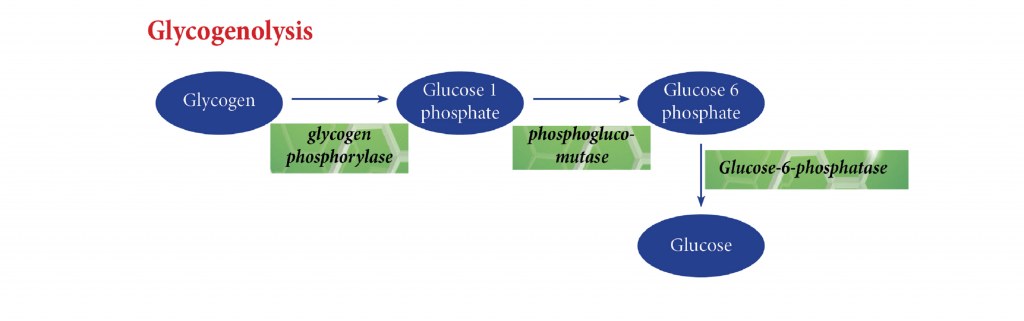
- Active glycogen phosphorylase (phosphorylase a) catalyzes the phosphorolytic cleavage of α-1,4 glycosidic bonds at the non-reducing ends of glycogen, releasing glucose-1-phosphate (G1P).
2. Phosphorolytic Cleavage
- Glycogen phosphorylase removes glucose units sequentially but stops four residues before an α-1,6 branch point, requiring additional enzymatic activity for further breakdown.
- The released glucose-1-phosphate is rapidly converted by phosphoglucomutase into glucose-6-phosphate (G6P), a central metabolic intermediate entering glycolysis, the pentose phosphate pathway, or free-glucose formation in the liver.
3. Debranching Enzyme Action
- The bifunctional debranching enzyme enables complete degradation of glycogen branches and consists of two catalytic activities: 4-α-D-glucanotransferase and α-1,6-glucosidase.
- Glucanotransferase transfers a block of three glucose residues from the branch to a nearby linear chain, enabling further action by glycogen phosphorylase.
- The α-1,6-glucosidase then hydrolyzes the remaining α-1,6-glycosidic bond, releasing one free glucose molecule and fully removing the branch point.
4. Conversion to Glucose
- In the liver, glucose-6-phosphatase dephosphorylates glucose-6-phosphate into free glucose, which is exported into the bloodstream to maintain systemic glucose homeostasis.
- Muscle cells lack glucose-6-phosphatase; therefore, glucose-6-phosphate remains intracellular and enters glycolysis to generate ATP for muscle contraction and energy-demanding processes.
|
|
Regulation
Glycogenolysis is finely regulated by hormonal and allosteric mechanisms. In the liver, glucagon and epinephrine activate glycogen breakdown when circulating glucose levels fall or during acute stress. In skeletal muscle, epinephrine and neural stimulation coordinate rapid glycogen mobilization during exercise. Conversely, insulin inhibits glycogenolysis by dephosphorylating key enzymes and promoting glycogen synthesis when blood glucose is abundant.
Summary Table: Core Steps in Glycogenolysis
|
Step
|
Enzyme(s)
|
Product
|
Tissue Specificity
|
| Phosphorylase activation | Glycogen phosphorylase | Glucose-1-phosphate | Liver, muscle |
| Branch removal | Debranching enzyme | Free glucose | Liver, muscle |
| Isomerization | Phosphoglucomutase | Glucose-6-phosphate | Liver, muscle |
| Glucose formation | Glucose-6-phosphatase | Free glucose | Liver only |
Glycogenolysis efficiently mobilizes stored glucose from glycogen during fasting, acute stress, and physical activity. Through the coordinated action of multiple enzymes and complex hormonal regulation, this pathway ensures rapid and controlled access to energy, supporting both immediate and long-term metabolic needs.