


Mouse anti-Human Filaggrin Antibody
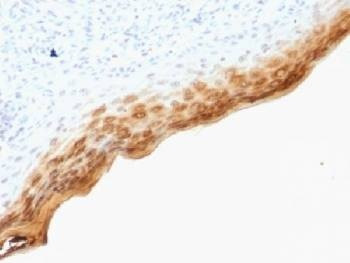
Anti-Filaggrin Antibody
Anti-Filaggrin Antibody
Contact Us for Bulk Request
Product Description
Specifications
| Size | 20 µg, 100 µg |
| Species | Human |
| Specificity | Other species not known |
| Host Species | Mouse |
| Accession Number | P20930 |
| Gene Id | 2312 |
| Gene Symbols | FLG |
| Protein Name / Synonyms | Filaggrin |
| Immunogen | A recombinant human FLG protein was used as the immunogen for this Filaggrin antibody. |
| Isotype | Kappa, IgG1 |
| Purity | Protein G affinity chromatography |
| Concentration (lot specific) | 0.2 mg/ml in 1X PBS with 0.1 mg/ml BSA (US sourced) and 0.05% sodium azide |
| Recommended Applications | FACS: 0.5-1ug/10^6 cells in 0.1ml IF: 1-2ug/ml IHC (FFPE): 0.5-1ug/ml for 30 min at RT |
| Domain / Region / Terminus | Cytoplasmic |
| Research Area | Inflammation |
| Shipping Type | Blue ice |
| Storage | ≤-20°C |
Description
Filaggrin (filament aggregating protein) is a filament-associated protein that binds to keratin fibers in epithelial cells. Ten to twelve filaggrin units are post-translationally hydrolized from a large profilaggrin precursor protein during terminal differentiation of epidermal cells. In humans, profilaggrin is encoded by the FLG gene, which is part of the S100 fused-type protein (SFTP) family within the epidermal differentiation complex on chromosome 1q21.
Filaggrin is essential for the regulation of epidermal homeostasis. Within the stratum corneum, filaggrin monomers can become incorporated into the lipid envelope, which is responsible for the skin barrier function. Alternatively, these proteins can interact with keratin intermediate filaments. Filaggrin undergoes further processing in the upper stratum corneum to release free amino acids that assist in water retention. [Wiki]
Storage
Store the Filaggrin antibody at 2-8°C (with azide) or aliquot and store at -20°C or colder (without azide).
Expiration:
12 months from the date of shipment when stored properly.