

Goat anti-LRP6 Antibody

Referencia MBS420538-0,1mg
embalaje : 0.1mg
Marca : MyBiosource
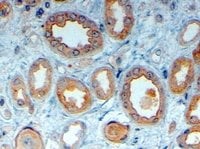
MBS420538 (4ug/ml) staining of paraffin embedded Human Kidney. Steamed antigen retrieval with citrate buffer pH 6, HRP-staining.
LRP6 Antibody – Goat Polyclonal
For Research Use Only. Not for use in diagnostic procedures. Catalog #: MBS420538MBS420538 is an antibody targeting LRP6. Also known as Goat anti-LRP6 Antibody. Reactive in Tested: Human; Expected from sequence similarity: Human, Mouse, Rat, Dog. Host: Goat. More details
Product Overview
Online Datasheet in PDFProduct Name
LRP6, Polyclonal Antibody
Full Product Name
Goat anti-LRP6 Antibody
Product Gene Name
anti-LRP6 antibody
Product Synonym Names
LRP6; low density lipoprotein receptor-related protein 6; low density lipoprotein-related protein 6; ADCAD2; FLJ90062; FLJ90421; LRP6 antibody; low density lipoprotein receptor-related protein 6 antibody; low density lipoprotein-related protein 6 antibody
Immunogen Sequence
CMTSVATAKG YTSDL
Clonality
Polyclonal
Host
Goat
Species Reactivity
Tested: Human; Expected from sequence similarity: Human, Mouse, Rat, Dog
Form/Format
Supplied at 0.5 mg/ml in Tris saline, 0. 02% sodium azide, pH7.3 with 0.5% bovine serum albumin.
Purity/Purification
Purified from goat serum by ammonium sulphate precipitation followed by antigen affinity chromatography using the immunizing peptide.
Concentration
100ug specific antibody in 200ul (lot specific)
Preparation and Storage
Aliquot and store at -20 degree C. Minimize freezing and thawing.
Antibody/Peptide Pairs
LRP6 peptide (MBS425279) is used for blocking the activity of LRP6 antibody (MBS420538)
Molecular Weight
180,429 Da
OMIM
603507
Immunogen
Peptide with sequence CMTSVATAKGYTSDL, from the internal region of the protein sequence according to NP_002327.2.
Epitope
Internal region
Note
This antibody is expected to recognise an epitope corresponding to aa 1546-1560 of human LRP6 protein.
ISO Certification
Manufactured in an ISO 9001:2008 Certified Laboratory.
Applications Tested/Suitable for anti-LRP6 antibody
Peptide ELISA (EIA), Immunohistochemistry (IHC)
Application Notes for anti-LRP6 antibody
Peptide ELISA: Antibody detection limit dilution 1: 64000.
Immunohistochemistry: In paraffin embedded Human Kidney shows luminar membrane staining in DCT. Recommended concentration, 4-6ug/ml.
Western Blot: Preliminary experiments gave bands at approx 50kDa and 35kDa in Human Adipose lysates after 0.1ug/ml antibody staining. Please note that currently we cannot find an explanation in the literature for the bands we observe given the calculated size of 180kDa according to NP_002327.2. Both detected bands were successfully blocked by incubation with the immunizing peptide (and BLAST results with the immunizing peptide sequence did not identify any other proteins to explain the additional bands).
Other Notes
Small volumes of anti-LRP6 antibody vial(s) may occasionally become entrapped in the seal of the product vial during shipment and storage. If necessary, briefly centrifuge the vial on a tabletop centrifuge to dislodge any liquid in the container`s cap. Certain products may require to ship with dry ice and additional dry ice fee may apply.
Additional Details
NCBI/Uniprot data below describe general gene information for LRP6. It may not necessarily be applicable to this product.
NCBI Official Full Name
low-density lipoprotein receptor-related protein 6
NCBI Official Synonym Full Names
LDL receptor related protein 6
NCBI Official Symbol
LRP6
NCBI Official Synonym Symbols
ADCAD2; STHAG7
UniProt Protein Name
Low-density lipoprotein receptor-related protein 6
Protein Family
Low-density lipoprotein receptor-related protein
UniProt Gene Name
LRP6
UniProt Synonym Gene Names
LRP-6
UniProt Entry Name
LRP6_HUMAN
NCBI Protein Information
low-density lipoprotein receptor-related protein 6
NCBI Summary for LRP6
This gene encodes a member of the low density lipoprotein (LDL) receptor gene family. LDL receptors are transmembrane cell surface proteins involved in receptor-mediated endocytosis of lipoprotein and protein ligands. The protein encoded by this gene functions as a receptor or, with Frizzled, a co-receptor for Wnt and thereby transmits the canonical Wnt/beta-catenin signaling cascade. Through its interaction with the Wnt/beta-catenin signaling cascade this gene plays a role in the regulation of cell differentiation, proliferation, and migration and the development of many cancer types. This protein undergoes gamma-secretase dependent RIP- (regulated intramembrane proteolysis) processing but the precise locations of the cleavage sites have not been determined.[provided by RefSeq, Dec 2009]
Show more UniProt Comments for LRP6
LRP6: Component of the Wnt-Fzd-LRP5-LRP6 complex that triggers beta-catenin signaling through inducing aggregation of receptor- ligand complexes into ribosome-sized signalsomes. Cell-surface coreceptor of Wnt/beta-catenin signaling, which plays a pivotal role in bone formation. The Wnt-induced Fzd/LRP6 coreceptor complex recruits DVL1 polymers to the plasma membrane which, in turn, recruits the AXIN1/GSK3B-complex to the cell surface promoting the formation of signalsomes and inhibiting AXIN1/GSK3- mediated phosphorylation and destruction of beta-catenin. Required for posterior patterning of the epiblast during gastrulation. Homodimer; disulfide-linked. Forms phosphorylated oligomer aggregates on Wnt-signaling. Forms a WNT-signaling complex formed of a WNT protein, a FZD protein and LRP5 or LRP6. Interacts (via the extracellular domain) with WNT1; the interaction is enhanced by prior formation of the Wnt/Fzd complex. Interacts (via the beta-propeller regions 3 and 4) with WNT3A. Interacts (via the beta-propeller regions 1 and 2) with WNT9B. Interacts with FZD5; the interaction forms a coreceptor complex for Wnt signaling and is inhibited by DKK1 and C1orf187. Interacts (via beta propeller region) with DKK1; the interaction inhibits FZD5/LRP6 complex formation. Interacts with DKK2. Interacts with C1orf187/DRAXIN; the interaction inhibits Wnt signaling. Interacts (via the phosphorylated PPPSP motifs) with AXIN1; the interaction recruits the AXIN1/GSK3B complex to cell surface LRP6 signalsomes. Interacts with GRB10; the interaction prevents AXIN1 binding, thus negatively regulating the Wnt signaling pathway. Interacts (via the extracellular domain) with RSPO1; the interaction activates Wnt/beta-catenin signaling. Interacts (via the extracellular domain) with RSPO3 (via the cysteine rich domain); the interaction activates Wnt/beta-catenin signaling. Interacts (via the beta- propeller regions 1 and 2) with SOST; the interaction competes with DKK1 for binding for inhibiting beta-catenin signaling. Interacts with MESD; the interaction prevents the formation of LRP6 aggregates and targets LRP6 to the plasma membrane. Interacts (via the cytoplasmic domain) with CSNKIE; the interaction phosphorylates LRP6, binds AXIN1 and inhibits AXIN1/GSK3B-mediated phosphorylation of beta-catenin. Interacts with MACF1. Decreased levels on WNT3A stimulation. Widely co-expressed with LRP5 during embryogenesis and in adult tissues. Belongs to the LDLR family.
Protein type: Receptor, misc.; Membrane protein, integral
Chromosomal Location of Human Ortholog: 12p13.2
Cellular Component: caveola; cell soma; cell surface; cytoplasmic vesicle; cytosol; early endosome; early endosome membrane; endoplasmic reticulum; extracellular region; Golgi apparatus; integral to membrane; plasma membrane; receptor complex; synapse
Molecular Function: apolipoprotein binding; frizzled binding; identical protein binding; kinase inhibitor activity; low-density lipoprotein receptor activity; protein binding; protein homodimerization activity; receptor binding; toxin transporter activity; Wnt receptor activity; Wnt-protein binding
Biological Process: cell-cell adhesion; cerebellum morphogenesis; cerebral cortex development; convergent extension; elevation of cytosolic calcium ion concentration; embryonic pattern specification; embryonic retina morphogenesis in camera-type eye; external genitalia morphogenesis; midbrain-hindbrain boundary development; negative regulation of protein amino acid phosphorylation; negative regulation of protein kinase activity; neural crest cell differentiation; neural crest formation; neural tube closure; odontogenesis of dentine-containing teeth; palate development; positive regulation of cell cycle; positive regulation of transcription factor activity; positive regulation of transcription from RNA polymerase II promoter; positive regulation of transcription, DNA-dependent; response to peptide hormone stimulus; synaptic transmission; thalamus development; Wnt receptor signaling pathway; Wnt receptor signaling pathway through beta-catenin
Disease: Coronary Artery Disease, Autosomal Dominant 2
Show more Protein type: Receptor, misc.; Membrane protein, integral
Chromosomal Location of Human Ortholog: 12p13.2
Cellular Component: caveola; cell soma; cell surface; cytoplasmic vesicle; cytosol; early endosome; early endosome membrane; endoplasmic reticulum; extracellular region; Golgi apparatus; integral to membrane; plasma membrane; receptor complex; synapse
Molecular Function: apolipoprotein binding; frizzled binding; identical protein binding; kinase inhibitor activity; low-density lipoprotein receptor activity; protein binding; protein homodimerization activity; receptor binding; toxin transporter activity; Wnt receptor activity; Wnt-protein binding
Biological Process: cell-cell adhesion; cerebellum morphogenesis; cerebral cortex development; convergent extension; elevation of cytosolic calcium ion concentration; embryonic pattern specification; embryonic retina morphogenesis in camera-type eye; external genitalia morphogenesis; midbrain-hindbrain boundary development; negative regulation of protein amino acid phosphorylation; negative regulation of protein kinase activity; neural crest cell differentiation; neural crest formation; neural tube closure; odontogenesis of dentine-containing teeth; palate development; positive regulation of cell cycle; positive regulation of transcription factor activity; positive regulation of transcription from RNA polymerase II promoter; positive regulation of transcription, DNA-dependent; response to peptide hormone stimulus; synaptic transmission; thalamus development; Wnt receptor signaling pathway; Wnt receptor signaling pathway through beta-catenin
Disease: Coronary Artery Disease, Autosomal Dominant 2
Precautions
All of MyBioSource's Products are for scientific laboratory research purposes and are not for diagnostic, therapeutics, prophylactic or in vivo use. Through your purchase, you expressly represent and warrant to MyBioSource that you will properly test and use any Products purchased from MyBioSource in accordance with industry standards. MyBioSource and its authorized distributors reserve the right to refuse to process any order where we reasonably believe that the intended use will fall outside of our acceptable guidelines.
Disclaimer
While every efforts were made to ensure the accuracy of the information provided in this datasheet, MyBioSource will not be liable for any omissions or errors contained herein. MyBioSource reserves the right to make changes to this datasheet at any time without prior notice.
It is the responsibility of the customer to report product performance issues to MyBioSource within 30 days of receipt of the product. Please visit our Terms & Conditions page for more information.
It is the responsibility of the customer to report product performance issues to MyBioSource within 30 days of receipt of the product. Please visit our Terms & Conditions page for more information.
Product Note
Select online data sheet information is drawn from bioinformatics databases, occasionally resulting in ambiguous or non-relevant product information. It is the responsibility of the customer to review, verify, and evaluate the information to make sure it matches their requirements before purchasing the kit. Our ELISA Kit assays are dynamic research tools and sometimes they may be updated and improved. If the format of this assay is important to you then please request the current manual or contact our technical support team with a presales inquiry before placing an order. We will confirm the current details of the assay. We cannot guarantee the sample manual posted online is the most current manual, it is intended to serve as an example only. Please refer to the instructions For Use provided with the assay kit for precise details.
Product PubMed Publications
Products associated with anti-LRP6 antibody
| Reference Product | PubMed Publications |
|---|---|
| WNT3A antibody | >122 publications with LRP6 and WNT3A |
| DKK1 antibody | >119 publications with LRP6 and DKK1 |
| WNT1 antibody | >49 publications with LRP6 and WNT1 |
| WNT5A antibody | >39 publications with LRP6 and WNT5A |
| GSK3B antibody | >26 publications with LRP6 and GSK3B |
| AXIN1 antibody | >22 publications with LRP6 and AXIN1 |
| DKK2 antibody | >21 publications with LRP6 and DKK2 |
| FZD5 antibody | >14 publications with LRP6 and FZD5 |
| FZD8 antibody | >7 publications with LRP6 and FZD8 |
| DVL1 antibody | >5 publications with LRP6 and DVL1 |
Pathways associated with anti-LRP6 antibody
| Products by Pathway | Pathway Diagram |
|---|---|
| Canonical Wnt Signaling Pathway antibodies | Canonical Wnt Signaling Pathway Diagram |
| Disassembly Of The Destruction Complex And Recruitment Of AXIN To The Membrane Pathway antibodies | Disassembly Of The Destruction Complex And Recruitment Of AXIN To The Membrane Pathway Diagram |
| Disease Pathway antibodies | Disease Pathway Diagram |
| Diseases Of Signal Transduction Pathway antibodies | Diseases Of Signal Transduction Pathway Diagram |
| MicroRNAs In Cardiomyocyte Hypertrophy Pathway antibodies | MicroRNAs In Cardiomyocyte Hypertrophy Pathway Diagram |
| Negative Regulation Of TCF-dependent Signaling By WNT Ligand Antagonists Pathway antibodies | Negative Regulation Of TCF-dependent Signaling By WNT Ligand Antagonists Pathway Diagram |
| Presenilin Action In Notch And Wnt Signaling Pathway antibodies | Presenilin Action In Notch And Wnt Signaling Pathway Diagram |
| RNF Mutants Show Enhanced WNT Signaling And Proliferation Pathway antibodies | RNF Mutants Show Enhanced WNT Signaling And Proliferation Pathway Diagram |
| Regulation Of FZD By Ubiquitination Pathway antibodies | Regulation Of FZD By Ubiquitination Pathway Diagram |
| Signal Transduction Pathway antibodies | Signal Transduction Pathway Diagram |
Diseases associated with anti-LRP6 antibody
| Disease Name | Pubmed Publications |
|---|---|
| Carcinoma Antibodies | >32 publications with LRP6 and Carcinoma |
| Inflammation Antibodies | >29 publications with LRP6 and Inflammation |
| Breast Neoplasms Antibodies | >23 publications with LRP6 and Breast Neoplasms |
| Liver Diseases Antibodies | >15 publications with LRP6 and Liver Diseases |
| Neoplasm Metastasis Antibodies | >12 publications with LRP6 and Neoplasm Metastasis |
| Fibrosis Antibodies | >11 publications with LRP6 and Fibrosis |
| Brain Diseases Antibodies | >11 publications with LRP6 and Brain Diseases |
| Kidney Diseases Antibodies | >11 publications with LRP6 and Kidney Diseases |
| Neoplasm Invasiveness Antibodies | >9 publications with LRP6 and Neoplasm Invasiveness |
| Embryo Loss Antibodies | >9 publications with LRP6 and Embryo Loss |
Organs/Tissues associated with anti-LRP6 antibody
| Organ/Tissue Name | Pubmed Publications |
|---|---|
| Bone Antibodies | >148 publications with LRP6 and Bone |
| Embryonic Tissue Antibodies | >45 publications with LRP6 and Embryonic Tissue |
| Blood Antibodies | >44 publications with LRP6 and Blood |
| Brain Antibodies | >44 publications with LRP6 and Brain |
| Eye Antibodies | >32 publications with LRP6 and Eye |
| Liver Antibodies | >31 publications with LRP6 and Liver |
| Muscle Antibodies | >24 publications with LRP6 and Muscle |
| Heart Antibodies | >19 publications with LRP6 and Heart |
| Kidney Antibodies | >18 publications with LRP6 and Kidney |
| Lung Antibodies | >18 publications with LRP6 and Lung |