

LY2109761 [700874-71-1]

Referencia T2123-2mg
embalaje : 2mg
Marca : TargetMol
LY2109761
Copy Product Info
LY2109761 is a novel selective TGF-β receptor type I/II (TβRI/II) dual inhibitor with Ki of 38 nM and 300 nM, respectively; shown to negatively affect the phosphorylation of Smad2.
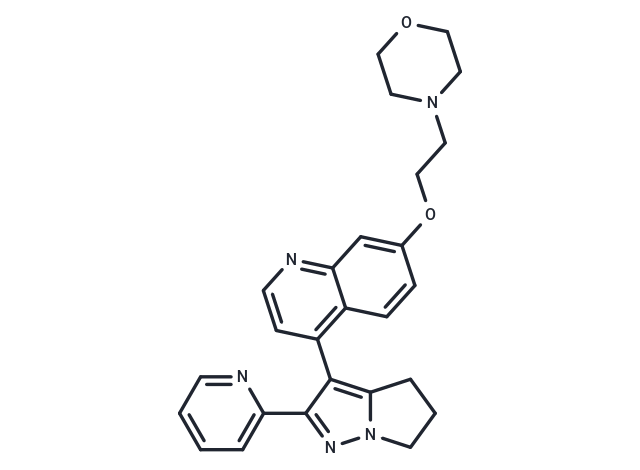
Cas No. 700874-71-1
For research use only—not for human use. No sales to individuals. Use as intended only.
Select Batch
Purity:99.99%
Color:White
COA LCMS HNMR
Product Information
Bioactivity
Chemical Properties
Storage & Solubility Information
| Description | LY2109761 is a novel selective TGF-β receptor type I/II (TβRI/II) dual inhibitor with Ki of 38 nM and 300 nM, respectively; shown to negatively affect the phosphorylation of Smad2. |
| Targets & IC50 | TβRII:300 nM (Ki, cell free), TβRI:38 nM (Ki, cell free) |
| In vitro | Targeting TβRI/II kinase activity with LY2109761 (5 μM) almost completely suppressed both the basal (P = 0.0107) and TGF-β1–stimulated migration of L3.6pl/GLT cells (P < 0.0001), indicating that the migration of L3.6pl/GLT cells in vitro is effectively driven by endogenous TGF-β [1]. LY2109761 (0.001-0.1 μM) up-regulates (P < 0.001) E-cadherin mRNA and protein levels. This increase was localized at the cellular membrane where E-cadherin mediates anchorage that is cell-cell dependent [2]. LY2109761 (10 μM) or radiation (4 Gy) alone reduced neurosphere-forming efficiency in NMA-23 cells. The combination of LY2109761 plus radiation had supra-additive effects in neurosphere formation and limiting dilution assays [3]. |
| In vivo | LY2109761 (50 mg/kg, p.o.) greatly reduced the tumor volume and increased the median survival duration of the mice to 45.0 days, but the differences were not significant. Only when LY2109761 was combined with gemcitabine were significant effects noted on tumor volume (P < 0.05) and median survival duration, which was increased to 77.5 days (P = 0.0018) [1]. In an orthotopic intracranial model, LY2109761 significantly reduced tumor growth, prolonged survival, and extended the prolongation of survival induced by radiation treatment. Histologic analyses showed that LY2109761 inhibited tumor invasion promoted by radiation, reduced tumor microvessel density, and attenuated mesenchymal transition [3]. |
| Cell Research | LY2109761 cytotoxicity was determined by 3 methods: the MTT assay, manual counting of viable cells, and propidium iodide staining. MTT yields a purple formazan product that is detected using a 96-well plate reader at 570 nm. Cells were plated and cultured for 2 days in a 1% fetal bovine serum medium supplemented with LY2109761 at the following concentrations: 0.001, 0.01, 0.1, 1, 10, and 20 μM. Each experimental condition was reproduced in 8 wells, and each experiment was repeated 3 times. To confirm the cytotoxic data, cells were incubated under the described conditions and stained with the vital dye trypan blue, which does not react with the cell membrane because of its negative charge. All the unstained cells were counted using a hemocytometer. Four squares were counted for each condition, and each condition was repeated in triplicate in the same experiment. Each experiment was repeated 3 times for each cell line. Bars represent the average and standard deviation of all experiments. Under the same experimental conditions, nonpermeabilized cells were stained with propidium iodide and analyzed with a flow cytometer [2]. |
| Animal Research | Three days after the orthotopic implantation of 1.0 × 10⁶ L3.6pl/GLT tumor cells in 50 μL of HBSS, when bioluminescence imaging confirmed that tumors were well established, 40 mice were randomly allocated into four groups (n = 10 mice per group) to receive one of the following treatments. (a) Vehicle solution for 50 μL of LY2109761 twice a day p.o. (days 1–5 of each week) and 50 μL of sterile saline daily i.p. (days 2 and 5 of each week; control group). (b) LY2109761 (50 mg/kg) twice a day p.o. (days 1–5 of each week) and 50 μL of sterile saline daily i.p. (days 2 and 5 of each week). (c) Gemcitabine (25 mg/kg) daily i.p. (days 2 and 5 of each week) and p.o. vehicle for 50μL of LY2109761 twice a day (days 1–5 of each week). (d) LY2109761 (50 mg/kg) twice a day (days 1–5 of each week) and gemcitabine (25 mg/kg) daily i.p. (days 2 and 5 of each week). Treatments were continued for 4 wk. All mice were weighed weekly and observed for tumor growth. Tumor diameter was assessed with a Vernier caliper, and tumor volume (mm3) was calculated as d2 × D/2, wherein d and D represent the shortest and longest diameters, respectively. Bulky disease was considered present when the tumor burden was prominent in the mouse abdomen (tumor volume, ≥2,000 mm3). When at least 6 of 10 mice in a treatment group presented with bulky disease, the median survival duration for that group was considered to be reached. At the median survival duration of the control group, the tumor growth in mice in all groups was evaluated using the bioluminescence emitted by the tumor cells. Bioluminescence imaging was conducted using a cryogenically cooled IVIS 100 imaging system coupled to a data acquisition computer running Living Image software. The mice were sacrificed by carbon dioxide inhalation when evidence of advanced bulky disease was present. The day of sacrifice was considered the day of death for survival evaluation [1]. |
| Molecular Weight | 441.52 |
| Formula | C26H27N5O2 |
| Cas No. | 700874-71-1 |
| Smiles | C(CN1CCOCC1)Oc1ccc2c(ccnc2c1)-c1c2CCCn2nc1-c1ccccn1 |
| Relative Density. | 1.34 g/cm3 |
| Storage | Store at low temperature Powder: -20°C for 3 years | In solvent: -80°C for 1 year Shipping with blue ice/Shipping at ambient temperature. | ||||||||||||||||||||
| Solubility Information | DMSO: 6.875 mg/mL (15.57 mM), Sonication is recommended.  Ethanol: Insoluble H2O: Insoluble | ||||||||||||||||||||
| In Vivo Formulation | 10% DMSO+40% PEG300+5% Tween 80+45% Saline: 1 mg/mL (2.26 mM), Sonication is recommended. Please add the solvents sequentially, clarifying the solution as much as possible before adding the next one. Dissolve by heating and/or sonication if necessary. Working solution is recommended to be prepared and used immediately. The formulation provided above is for reference purposes only. In vivo formulations may vary and should be modified based on specific experimental conditions. | ||||||||||||||||||||
Solution Preparation Table | |||||||||||||||||||||
DMSO
Note : The dilution table applies only to solid products. For liquid products, please calculate the stock solution based on the stated concentration and/or density. | |||||||||||||||||||||