Mouse CD22 Antibody : PE

Referencia OASB00366
embalaje : 0.1mg
Marca : Aviva Systems Biology
Mouse CD22 Antibody : PE (OASB00366)
| Datasheets/Manuals | Printable datasheet for Mouse CD22 Antibody : PE (OASB00366) |
|---|
| Tested Species Reactivity | Mouse |
|---|---|
| Predicted Species Reactivity | Mouse |
| Clonality | Monoclonal |
| Clone | 2D6 |
| Isotype | IgG1 |
| Host | Rat |
| Conjugation | R-PE |
| Application | FC |
| Additional Information | Description: CD22, also known as Lyb-8, is a heterodimeric transmembrane glycoprotein and a member of a structurally related group of immunoglobulin (Ig) superfamily domain-containing proteins called the sialoadhesin family. It is detected in the cytoplasm early in B cell development (late pro-B cell stage), appears on the cell surface concomitant with IgD, and is found on most IgM+IgD+ mature B lymphocytes. Expression is lost with terminal differentiation of B cells and is absent on plasma cells. Activation of B cells via cross-linking of surface Ig increases CD22 expression. CD22 associates with the B cell receptor (BCR) complex and mediates intercellular adhesion. Its intracellular domain is phosphorylated after antigen receptor cross-linking and is involved in negative regulation of B cell activation. |
| Reconstitution and Storage | Store at 2-8C |
| Immunogen | Splenic lymphocyte plasma membranes from CBA x C57 F1 mice |
| Concentration | 0.1 mg/mL |
| Specificity | CD22 |
| Characterization | To ensure lot- to- lot consistency, each batch of monoclonal antibody is tested by flow cytometry to conformto characteristics of a standard reference reagent. Representative data are included in this product insert. |
| Warning | Reagents contain sodium azide. Sodium azide is very toxic if ingested or inhaled. Avoid contact withskin, eyes, or clothing. Wear eye or face protection when handling. If skin or eye contact occurs, washwith copious amounts of water. If ingested or inhaled, contact a physician immediately. Sodium azideyields toxic hydrazoic acid under acidic conditions. Dilute azide- containing compounds in running waterbefore discarding to avoid accumulation of potentially explosive deposits in lead or copper plumbing. |
| Dilution | Flow Cytometry: Fluorescein conjugate <= 1 ug/106 cells Biotin conjugate <= 1 ug/106 cells R-phycoerythrin conjugate <= 0.2 ug/106 cells Allophycocyanin conjugate <= 0.2 ug/106 cells Spectral Red conjugate <= 0.2 ug/106 cells |
| Application Info | Flow cytometry 2, Immunoprecipitation 2 |
| Other Applications Data | Since applications vary, you should determine the optimum workingdilution for the product that is appropriate for your specific need. |
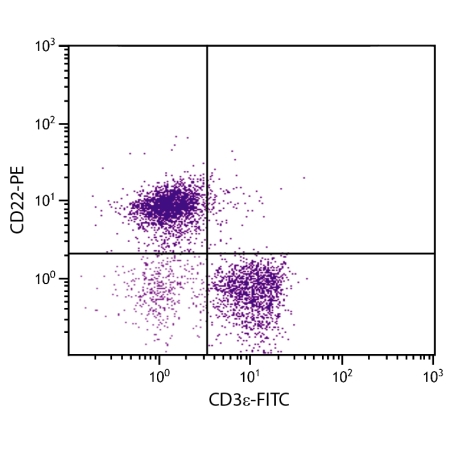
| Other Applications Image 1 Data | Amount Used: 0.3 Ug/106 cells BALB/c splenocytes were double-stained with rat anti-mouse CD22-R-PE and rat anti-mouse CD19-FITC. Small lymphocytes were gated and analyzed on a FACScan flow cytometer (BDIS, San Jose, CA). |
| Storage | - The purified (UNLB) antibody is supplied as 0.5 mg of purified immunoglobulin in 1.0 mL of 100 mMborate buffered saline, pH 8.2. No preservatives or amine- containing buffer salts added. Store at 2- 8 C - The fluorescein (FITC) conjugate is supplied as 0.5 mg in 1.0 mL of PBS/NaN3. Store at 2- 8 C - The biotin (BIOT) conjugate is supplied as 0.5 mg in 1.0 mL of PBS/NaN3. Store at 2- 8 C - The R- phycoerythrin (R- PE) and allophycocyanin (APC) conjugates are supplied as 0.1 mg in 1.0 mLof PBS/NaN3 and a stabilizing agent. Store at 2- 8 C. Do not freeze! - The Spectral Red (SPRD) conjugate is supplied as 0.1 mg in 1.0 mL of PBS/NaN3 and a stabilizingagent. Store at 2- 8 C. Do not freeze! - The low endotoxin, azide- free (LE/AF) antibody is supplied as 0.5 mg purified immunoglobulin in 1.0 mLof PBS. Aliquot and store at or below - 20 C - Protect conjugated forms from light. Aliquot and freeze the low endotoxin, azide- free product at - 20 Cimmediately upon receipt. Each reagent is stable for the period shown on the bottle label if stored asdirected. |
| Reference | 1. Symington, F.W., B. Subbarao, D.E. Mosier, and J. Sprent. 1982. Immunogenetics 16:381 2. Torres, R.M., C- L. Law, L. Santos- Argumedo, P.A. Kirkham, K. Grabstein, R.M.E. Parkhouse, and E.A. Clark. 1992. J. Immunol. 149:2641 3. Erickson, L.D., L.T. Tygrett, S.K. Bhatia, K.H. Grabstein, and T.J. Waldschmidt. 1996. Int. Immunol. 8:1121 4. Law C.- L. Aruffo, A. Chandran, K.A. Doty, R.T. and Clark, E.A. 1995. J. Immunol. 155:3368 5. Law, C.- L., S.P. Sidorenko, and E.A. Clark. 1994. Immunol. Today 15:442 6. Pezzutto, A., Dorken, B., Moldenhauer, G. amd Clark, E.A. 1988. J. Immunol. 140:1791 7. Doody, G.M., L.B. Justement, C.C. Delbrias, R.J. Matthews, J. Lin, M.L. Thomas, and D.T. Fearon. 1995. Science 269:242 8. Law, C.- L., S.P. Sidorenko, K.A. Chandran, Z. Zhao, S.- H. Shen, E.H. Fischer, and E.A. Clark. 1996. J. Exp. Med. 183:547 9. O'Keefe, T.L., G.T. Williams, S.L. Davies, and M.S. Neuberger. 1996. Science 274:798. |
|---|---|
| Gene Symbol | CD22 |
| Gene Full Name | B-cell receptor CD22 |
| Alias Symbols | Lyb, Lyb-, Lyb8, Lyb-8, A530093D23 |
| NCBI Gene Id | 12483 |
| Protein Name | B-cell receptor CD22 |
| Uniprot ID | P35329 |
| Protein Accession # | NP_001036782.1 |
| Nucleotide Accession # | NM_001043317.2 |