

Noggin/NOG Protein, Human, Recombinant (hFc)

Referencia NB-64-56075-10ug
embalaje : 10ug
Marca : Neo Biotech
Remove All
Noggin/NOG Protein, Human, Recombinant (hFc)
(Synonyms: SYNS1, SYM1, Noggin) Copy Product InfoSynonyms: SYNS1, SYM1, Noggin
Catalog No. TMPY-00890 Copy Product Info
Purity: 96.8%
Noggin/NOG Protein, Human, Recombinant (hFc) is expressed in HEK293 mammalian cells with hFc tag. The predicted molecular weight is 49.8 kDa and the accession number is Q13253.
For research use only—not for human use. No sales to individuals. Use as intended only.
Select Batch
Purity:96.8%
Appearance:Lyophilized powder
Color:White
Contact us for more batch information
Product Information
Bioactivity
Chemical Properties
Storage & Solubility Information
| Bioactivity | Measured by its ability to inhibit BMP4-induced alkaline phosphatase production by MC3T3-E1 cells. The ED50 for this effect is typically 0.1-0.6 μg/mL in the presence of 25 ng/mL of hBMP4. |
| Description | Noggin/NOG Protein, Human, Recombinant (hFc) is expressed in HEK293 mammalian cells with hFc tag. The predicted molecular weight is 49.8 kDa and the accession number is Q13253. |
| Species | Human |
| Expression System | HEK293 Cells |
| Tag | C-hFc |
| Accession Number | Q13253 |
| Construction | A DNA sequence encoding the human Noggin precursor (NP_005441.1) (Met 1-Cys 232) was fused with the Fc region of human IgG1 at the C-terminus. Predicted N terminal: Gln 28 |
| Protein Purity | > 95 % as determined by SDS-PAGE 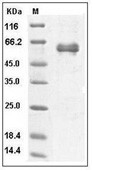 |
| Endotoxin | < 1.0 EU/μg of the protein as determined by the LAL method. |
| Formulation | Lyophilized from a solution filtered through a 0.22 μm filter, containing 100 mM Glycine, 10 mM NaCl, 50 mM Tris, pH 7.5. Typically, a mixture containing 5% to 8% trehalose, mannitol, and 0.01% Tween 80 is incorporated as a protective agent before lyophilization. |
| Reconstitution | Reconstituted with sterile deionized water to 0.25 mg/mL. Reconstitution conditions may vary depending on the lot. |
| Synonyms | SYNS1, SYM1, Noggin |
| Research Background | Noggin is a secreted protein involved at multiple stages of vertebrate embryonic development including neural induction and is known to exert its effects by inhibiting the bone morphogenetic protein (BMP)-signaling pathway. It binds several BMPs with very high (picomolar) affinities, with a marked preference for BMP2 and BMP4 over BMP7. By binding tightly to BMPs, Noggin prevents BMPs from binding their receptors. Noggin binds the bone morphogenetic proteins (BMP) such as BMP-4 and BMP-7 and inhibits BMP signaling by blocking the molecular interfaces of the binding epitopes for both types I and type II receptors. Interaction of BMP and its antagonist Noggin governs various developmental and cellular processes, including embryonic dorsal-ventral axis, induction of neural tissue, the formation of joints in the skeletal system, and neurogenesis in the adult brain. Noggin plays a key role in neural induction by inhibiting BMP4, along with other TGF-β signaling inhibitors such as chordin and follistatin. Mouse knockout experiments have demonstrated that noggin also plays a crucial role in bone development, joint formation, and neural tube fusion. |
| Molecular Weight | 49.8 kDa (predicted); 58-62 kDa (reducing condition, due to glycosylation) |
| Shipping | In general, lyophilized powders are shipped with blue ice, while solutions are shipped with dry ice. |
| Storage | It is recommended to store recombinant proteins at -20°C to -80°C for future use. Lyophilized powders can be stably stored for over 12 months, while liquid products can be stored for 6-12 months at -80°C. For reconstituted protein solutions, the solution can be stored at -20°C to -80°C for at least 3 months. Please avoid multiple freeze-thaw cycles and store products in aliquots. |
Calculator
Dose Conversion
Keywords
SYNS-1SYNS 1SYM-1SYM 1
Preview
Related Tags: Noggin/NOG Protein, Human, Recombinant (hFc) chemical structure | Noggin/NOG Protein, Human, Recombinant (hFc) molecular weight
Generate Quote
Catalog No.: Cas No.:
Add
| Size | Quantity | Unit Price | Amount | Operation |
|---|
Generate Quote