

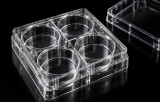
The 4-well plate is a low-throughput multiwell format used in cell and tissue culture when a small number of samples must be processed with generous surface area and medium volume per well. It occupies a niche between single dishes and higher-density multiwell plates, offering the convenience of a shared plate format while preserving the spacious growth environment required for primary cells, stem cells, organoids, and other demanding cultures. Typical working volumes are moderate, and the growth surface per well is substantially larger than that of 6-, 12-, or 24-well formats, making it suitable for applications where cell yield, morphological detail, or manipulation space is important.
Materials and Manufacturing
Four-well plates are generally manufactured from optical-grade polystyrene, selected for its clarity, chemical inertness, and compatibility with biological systems. The polymer conforms to established biocompatibility standards suitable for direct contact with cells and culture media. Its optical properties permit reliable microscopic observation, while mechanical stability supports routine handling, incubation, and centrifugation. Manufacturing is controlled to ensure consistent well geometry, surface uniformity, and low levels of extractable substances. Some variants incorporate glass bottoms or other specialized substrates for high-resolution imaging and micromanipulation.
Surface Treatments
Surface chemistry strongly influences cell behavior in 4-well plates. Non-treated plates retain a hydrophobic surface that minimizes protein adsorption and cell attachment, making them suitable for suspension cultures. Tissue-culture-treated plates undergo physical or chemical modification that introduces hydrophilic functional groups, promoting serum-protein adsorption and integrin-mediated adhesion of common adherent cell lines. Advanced superhydrophilic treatments further improve attachment and growth of fastidious cells, primary cells, and transfection cell lines, particularly under low-serum or serum-free conditions. The choice of surface treatment is critical for maintaining pluripotency, differentiation potential, or specialized functions in sensitive cell types.
