


2X Lysis Buffer for Antibody Array Kits
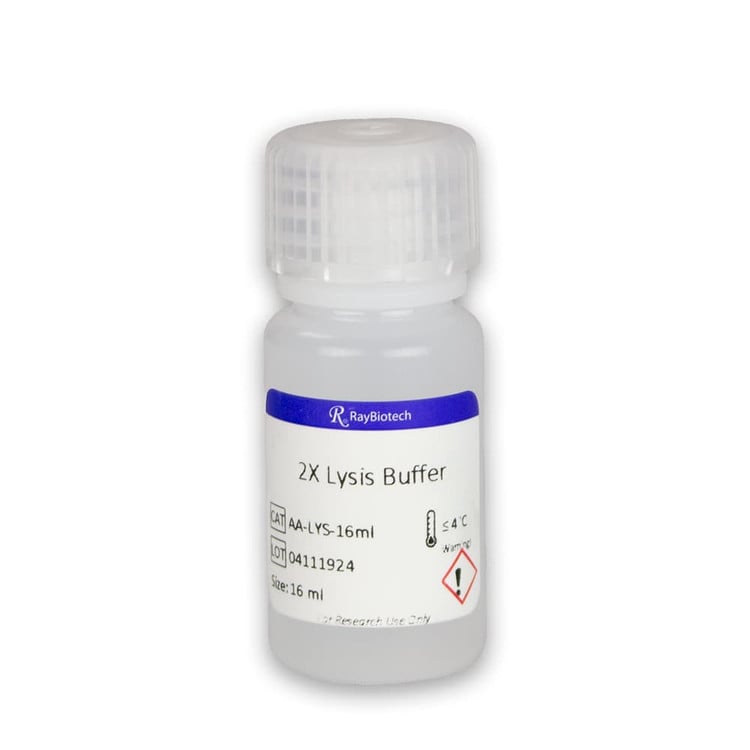
2X Lysis Buffer
2X Lysis Buffer
Contact Us for Bulk Request
Product Description
Specifications
| Size | 10 mL, 16 mL |
| Shipping Type | Blue ice |
| Storage | 2-8°C |
2X Lysis Buffer for Antibody Array Kits
2X Lysis Buffer Preparation Instructions
2X Lysis Buffer should be diluted 2-fold with deionized or distilled water. Supplementation with protease or phosphatase inhibitors is recommended. You may use RayBiotech Protease Inhibitor Cocktail (AA-PI), RayBiotech Phosphatase Inhibitor Cocktail Set I (AA-PHI-I) or Phosphatase Inhibitor Cocktail Set II (AA-PHI-II), or the RayBiotech Phosphatase / Protease Inhibitor Set (AA-PIPHI). Alternatively, you can purchase inhibitor cocktails from another manufacturer and follow their specifications.
Lysate Preparation
Cell Lysates
Rinse cells with PBS, taking care to remove any remaining PBS before detaching cells. Detach 2 x 10⁷ cells by trypsinization or scraping and transfer the cells to a microfuge tube. Centrifuge to pellet the cells and then remove any remaining buffer. Add ~500 µl prepared lysis buffer and pipette up and down to resuspend the pellet. Incubate the lysates with shaking at 4° C for 30 minutes. Spin down the tubes in a microfuge at top speed for 10 minutes at (4°C), and transfer the supernatants to a clean tube.
Tissue Lysates
Transfer approximately 100 mg crude tissue into a tube with 1 ml 1X Lysis Buffer. Homogenize the tissue according to homogenizer manufacturer instructions. Transfer extracts to microfuge tubes and centrifuge at top speed for 20 minutes (4°C).
Lysate Application
Cell or tissue lysates should be used immediately or aliquoted and stored at –80°C. Avoid repeated freeze-thaw cycles. Thawed lysates should be kept on ice prior to use.
For the first experiment, we recommend serial dilution testing, starting with a 5-fold dilution, to determine the optimal protein load for the assay. Optimal dilution depends on the abundance of target proteins and should be determined empirically.
The total protein concentration may be determined using the BCA Protein Assay Kit from Pierce, Cat#: 23227. We recommended to dilute your lysate to a final total protein concentration of 50-500 ug/ml (5-fold or more is preferred) when performing antibody array or ELISA testing.
Storage
Store at 4°C for 6 months or frozen at -80°C for 1 year
documents
citations
RAS/MEK/PI3K pathway inhibition augments response to CD40 agonism by targeting CD11b+ Bregs thereby overcoming melanoma PD1-resistance
- Species:
- Mouse
- Sample Type:
- Other / Unspecified (B16F10-Luc cells)
- Year:
- 2026
- Journal Name:
- Nature Communications
- PubMed ID:
- 41526341
Area postrema neurons mediate interleukin-6 function in cancer cachexia
- Year:
- 2024
- Journal Name:
- Nature Communications
- PubMed ID:
- 38824130
Ovariectomy Induces Selective Alterations in Dura Mater Blood and Lymphatic Microvascular Network Architecture in Mice
- Species:
- Mouse
- Sample Type:
- Tissue Lysate / Homogenate (dura mater tissues)
- Year:
- 2025
- Journal Name:
- Cells
- PubMed ID:
- 41227292
Oregano essential oil: a pre-harvest tool to reduce Salmonella enterica serovar Enteritidis in market-age broilers
- Species:
- Chicken
- Sample Type:
- Other / Unspecified (cecal tonsil)
- Year:
- 2026
- Journal Name:
- Poultry Science
- PubMed ID:
- 42061244
Ketogenic diet promotes tumor ferroptosis but induces relative corticosterone deficiency that accelerates cachexia
- Year:
- 2023
- Journal Name:
- Cell Metabolism
Platelet-derived chemokines promote skeletal muscle regeneration by guiding neutrophil recruitment to injured muscles
- Year:
- 2023
- Journal Name:
- Nature Communications
Histone Methyltransferase KMT2B Promotes Metastasis and Angiogenesis of Cervical Cancer by Upregulating EGF Expression
- Year:
- 2023
- Journal Name:
- International Journal of Biological Sciences
- PubMed ID:
- 36594087
RIPK1 Drives JAK1-STAT3 Signaling to Promote CXCL1-Mediated Neutrophil Recruitment in Sepsis-Induced Lung Injury
- Species:
- Mouse
- Sample Type:
- Other / Unspecified (MLE-12 cells)
- Year:
- 2025
- Journal Name:
- Advanced science (Weinheim, Baden-Württemberg, Germany)
- PubMed ID:
- 40953301
Local application of engineered insulin-like growth factor I mRNA demonstrates regenerative therapeutic potential in vivo
- Year:
- 2023
- Journal Name:
- Molecular Therapy-Nucleic Acids
Mechanochemical coupling of MGF mediates periodontal regeneration
- Year:
- 2023
- Journal Name:
- Bioengineering & translational medicine