LY9 Antibody

Referencia OAEE00737
embalaje : 100tests(T100)
Marca : Aviva Systems Biology
| Datasheets/Manuals | Printable datasheet for LY9 Antibody |
|---|
| Predicted Species Reactivity | Human |
|---|---|
| Product Format | Stabilizing phosphate buffered saline (PBS), pH 7.4, 15 mM sodium azide |
| Clonality | Monoclonal |
| Clone | HLy9.25 |
| Isotype | IgG1 |
| Host | Mouse |
| Conjugation | R-PE |
| Application | FC |
| Reconstitution and Storage | 2°C to 8°C |
| Immunogen | CD299-transfected 300.19 pre-B cell line |
| Purification | Purified by size-exclusion chromatography |
| Concentration | 20 ul / test |
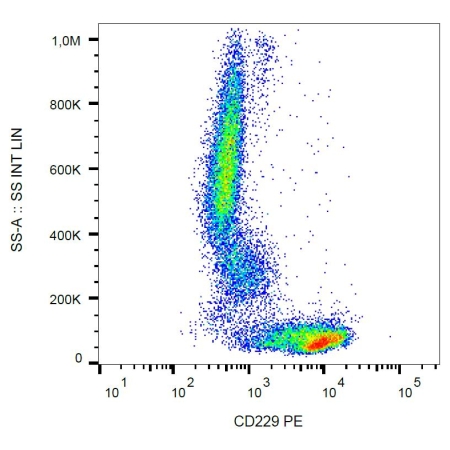
| Specificity | The mouse monoclonal antibody HLy9.25 (also known as HLy9.1.25) recognizes CD229 / Ly9, a 100-120 kDa cell surface glycoprotein expressed on T and B cells. |
| Formulation | PE |
| Storage Buffer | The reagent is provided in phosphate buffered saline (PBS) containing 15 mM sodium azide and 0.2% (w/v) high-grade protease free Bovine Serum Albumin (BSA) as a stabilizing agent. |
| Reference | Martín M, Del Valle JM, Saborit I, Engel P: Identification of Grb2 as a novel binding partner of the signaling lymphocytic activation molecule-associated protein binding receptor CD229. J Immunol. 2005 May 15;174(10):5977-86. Romero X, Zapater N, Calvo M, Kalko SG, de la Fuente MA, Tovar V, Ockeloen C, Pizcueta P, Engel P: CD229 (Ly9) lymphocyte cell surface receptor interacts homophilically through its N-terminal domain and relocalizes to the immunological synapse. J Immunol. 2005 Jun 1;174(11):7033-42. de la Fuente MA, Tovar V, Villamor N, Zapater N, Pizcueta P, Campo E, Bosch J, Engel P: Molecular characterization and expression of a novel human leukocyte cell-surface marker homologous to mouse Ly-9. Blood. 2001 Jun 1;97(11):3513-20. Sintes J, Romero X, Marin P, Terhorst C, Engel P: Differential expression of CD150 (SLAM) family receptors by human hematopoietic stem and progenitor cells. Exp Hematol. 2008 Sep;36(9):1199-204. Romero X, Benítez D, March S, Vilella R, Miralpeix M, Engel P: Differential expression of SAP and EAT-2-binding leukocyte cell-surface molecules CD84, CD150 (SLAM), CD229 (Ly9) and CD244 (2B4). Tissue Antigens. 2004 Aug;64(2):132-44. Bund D, Mayr C, Kofler DM, Hallek M, Wendtner CM: Human Ly9 (CD229) as novel tumor-associated antigen (TAA) in chronic lymphocytic leukemia (B-CLL) recognized by autologous CD8+ T cells. Exp Hematol. 2006 Jul;34(7):860-9. Del Valle JM, Engel P, Martín M: The cell surface expression of SAP-binding receptor CD229 is regulated via its interaction with clathrin-associated adaptor complex 2 (AP-2). J Biol Chem. 2003 May 9;278(19):17430-7. |
|---|---|
| Gene Symbol | LY9 |
| Gene Full Name | lymphocyte antigen 9 |
| Alias Symbols | CD229, cell surface molecule Ly-9, hly9, Lymphocyte antigen 9, mLY9, signaling lymphocytic activation molecule 3, SLAM family member 3, SLAMF3, T-lymphocyte surface antigen Ly-9. |
| NCBI Gene Id | 4063 |
| Protein Name | T-lymphocyte surface antigen Ly-9 |
| Description of Target | Self-ligand receptor of the signaling lymphocytic activation molecule (SLAM) family. SLAM receptors triggered by homo- or heterotypic cell-cell interactions are modulating the activation and differentiation of a wide variety of immune cells and thus are involved in the regulation and interconnection of both innate and adaptive immune response. Activities are controlled by presence or absence of small cytoplasmic adapter proteins, SH2D1A/SAP and/or SH2D1B/EAT-2. May participate in adhesion reactions between T lymphocytes and accessory cells by homophilic interaction. Promotes T-cell differentiation into a helper T-cell Th17 phenotype leading to increased IL-17 secretion; the costimulatory activity requires SH2D1A (PubMed:22184727). Promotes recruitment of RORC to the IL-17 promoter (PubMed:22989874). May be involved in the maintenance of peripheral cell tolerance by serving as a negative regulator of the immune response. May disable autoantibody responses and inhibit IFN-gamma secretion by CD4(+) T-cells. May negatively regulate the size of thymic innate CD8(+) T-cells and the development of invariant natural killer T (iNKT) cells (By similarity). |
| Uniprot ID | Q9HBG7 |
| Protein Accession # | NP_001028839.1; NP_001248385.1; NP_002339.2 |
| Nucleotide Accession # | NM_001033667.2; NM_001261456.1; NM_002348.3 |