

Plant hormone abscisic acid,ABA ELISA Kit

Referencia CSB-E09159Pl-48T
embalaje : 48T
Marca : Cusabio
| Size | 96T,5×96T,10×96T |
Product Details
| Intra-assay Precision (Precision within an assay): CV%<10% | ||||||
| Three samples of known concentration were tested twenty times on one plate to assess. | ||||||
| Inter-assay Precision (Precision between assays): CV%<20% | ||||||
| Three samples of known concentration were tested in twenty assays to assess. | ||||||
| The recovery of plant ABA spiked to levels throughout the range of the assay in various matrices was evaluated. Samples were diluted prior to assay as directed in the Sample Preparation section. | ||||||
| Sample Type | Average % Recovery | Range | ||||
| Xylem saps from plants (n=5) | 95 | 89-98 | ||||
| Crude extracts (n=5) | 95 | 90-100 | ||||
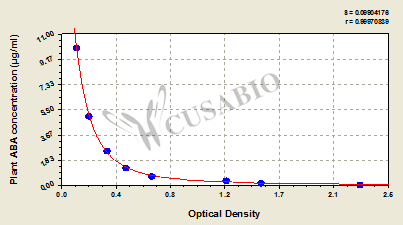
| These standard curves are provided for demonstration only. A standard curve should be generated for each set of samples assayed. | |||||||||||||||||||||||||||||||||||||||||||||||||||||||||||||||
| |||||||||||||||||||||||||||||||||||||||||||||||||||||||||||||||
and FAQs
This Plant ABA ELISA Kit was designed for the quantitative measurement of Plant ABA protein in plant tissues. It is a Competitive ELISA kit, its detection range is 0.156 μg/mL-10 μg/mL and the sensitivity is 0.04 μg/mL.
Citations
- J Lu, X Cui, Z Chang, S Yan, Y Li, Y Xiang, J Fan,Agricultural Water Management,2026
- CM Kambona, M Schneider, F He,Journal of Experimental Botany,2026
- NO Kalinina, N Spechenkova, I Ilina,International Journal of Molecular Sciences,2024
- M Suzuki,/,2024
- W Mphande,/,/
- J Iglesias-Moya,Plant science,2023
- G De Lorenzis,SSRN,2023
- W Mphande,Journal of Agronomy and Crop Science,2023
- M Jamilena,/,2023
- D Bianchi,Plants,2023
Customer Reviews and Q&A
There are currently no reviews for this product.
When the samples are ground, does it matter how quickly they are processed – I have hundreds of samples and I think I will have to grind at least 96/per kit before processing a set. Is the time taken after grinding before processing further limited, just in case the sample changes its chemical composition?
My samples are wheat leaves grown under drought conditions. Some of them are small collections and I am concerned they may not reach 0.5 g as stated in the protocol. If say the sample is less than 05.g, e.g. 0.4g, does that mean I will need to use 3.6 ml of the extraction buffer, since 0.5 g to 4.5 ml is 1: 9 in ratio terms.
It is recommended to grind the sample well and then process further on testing soon.
As you mentioned that you need to prepare large QTY sample, here advice you to store the first prepared sample ...
The freshly stored wheat leaf samples at -80 degrees Celsius will need to be freeze-dried – please state for how this needs to be. In addition, how is the grinding performed? What tools are used?
Yes, the freshly stored wheat leaf samples at -80 degrees Celsius will need to be freeze-dried. You already keep them at -80 degrees Celsius, the samples are through the freeze-dried process indeed.
When do make the test, pls take 0.5g out and use the mortar usually used in lab to grind the freeze-dried samples. ...