

Glycogenesis pathway
Glycogenesis is a fundamental metabolic process through which excess glucose molecules are converted into glycogen, a branched polysaccharide that serves as a principal storage form of glucose in liver and muscle cells. This anabolic pathway is essential for maintaining blood glucose homeostasis and providing a readily mobilizable energy reserve during periods of fasting or increased energy demand. Glycogenesis is tightly regulated by hormonal signals and multiple enzymatic steps ensuring proper balance between storage and utilization of glucose.
Biochemical Steps of Glycogenesis
1. Glucose Uptake and Phosphorylation
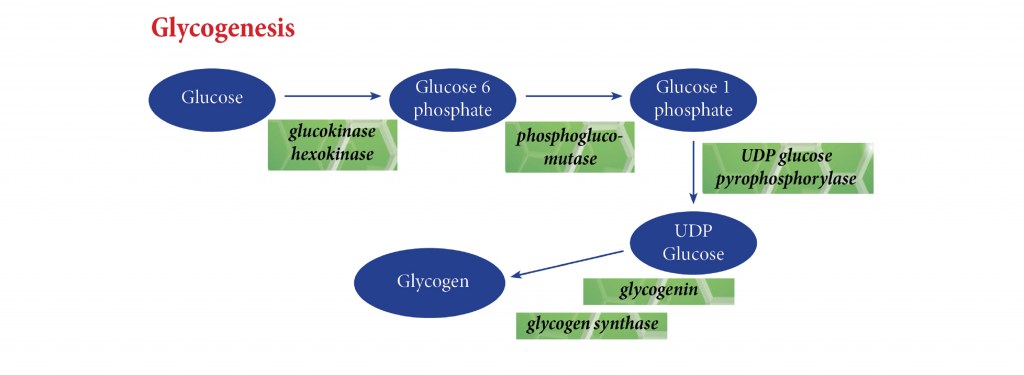
Glucose molecules are first taken up into cells via glucose transporters. Upon entry, glucose is phosphorylated by hexokinase (in muscle and most tissues) or glucokinase (in liver) to glucose-6-phosphate (G6P). This phosphorylation traps glucose intracellularly and primes it for further metabolism.
2. Conversion to Glucose-1-Phosphate
The enzyme phosphoglucomutase catalyzes the reversible isomerization of G6P to glucose-1-phosphate (G1P), a critical precursor for glycogen synthesis.
3. Formation of UDP-Glucose
G1P reacts with uridine triphosphate (UTP), catalyzed by UDP-glucose pyrophosphorylase, to form UDP-glucose. This activated glucose donor is essential for glycogen biosynthesis. The reaction releases pyrophosphate (PPi), which, upon hydrolysis, drives the reaction forward energetically.
4. Glycogen Primer Formation
Glycogen synthesis requires a primer. The enzyme glycogenin autoglucosylates itself by transferring glucose molecules from UDP-glucose to tyrosine residues, forming an oligosaccharide chain of approximately 8-10 glucose units. This primer serves as the foundation for glycogen polymer growth.
5. Glycogen Chain Elongation
Glycogen synthase extends the glycogen chain by catalyzing the transfer of glucose from UDP-glucose to the non-reducing ends of the growing polymer via α-1,4-glycosidic bonds. This enzyme is the rate-limiting and major regulatory enzyme of glycogenesis.
6. Branch Formation
The glycogen branching enzyme introduces α-1,6-glycosidic linkages approximately every 8 to 12 glucose residues. It cleaves a segment of the α-1,4-linked glucosyl chain and reattaches it via an α-1,6 bond, creating branch points that enhance solubility and accessibility of glycogen for synthesis and degradation.
|
|
Regulation of Glycogenesis
Glycogenesis is hormonally regulated: insulin stimulates glycogen synthase activation by promoting its dephosphorylation, favoring glycogen storage. Conversely, glucagon and epinephrine inhibit glycogen synthase through phosphorylation, reducing glycogenesis during fasting or stress. This reciprocal regulation coordinates glycogen synthesis and glycogenolysis in response to physiological energy needs.
Physiological Significance
Liver glycogen serves as a glucose reservoir released into the bloodstream during fasting to maintain normoglycemia. Muscle glycogen acts as a local energy store rapidly mobilized during exercise. Proper glycogen synthesis is vital for energy homeostasis; defects in this pathway lead to glycogen storage diseases marked by hypoglycemia, muscle weakness, and organ dysfunction.
In conclusion, glycogenesis is a complex, multi-step enzymatic process converting glucose into glycogen for energy storage. It involves glucose phosphorylation, activation to UDP-glucose, primer synthesis by glycogenin, chain elongation by glycogen synthase, and branching by branching enzyme. This pathway is tightly regulated to meet the cellular and systemic energy demands, underscoring its central role in metabolic physiology.