

Clinisciences > VDAC2 Antibody - N-terminal region
VDAC2 Antibody - N-terminal region

Referencia ARP35123_P050-25UL
embalaje : 25ul
Marca : Aviva Systems Biology
VDAC2 Antibody - N-terminal region (ARP35123_P050)
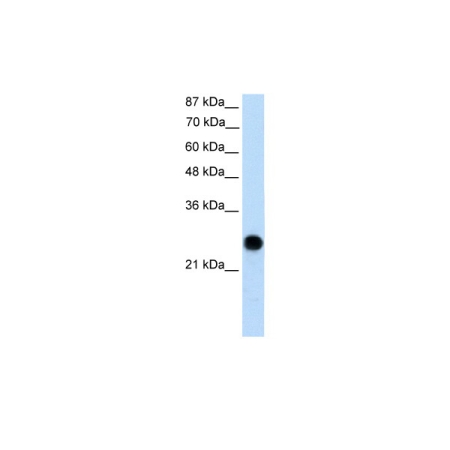
| Datasheets/Manuals | Printable datasheet for anti-VDAC2 (ARP35123_P050) antibody |
|---|
| Publications | Hrabakova, R. et al. Cancer cell resistance to aurora kinase inhibitors: identification of novel targets for cancer therapy. J. Proteome Res. 12, 455-69 (2013). 23151231 |
|---|---|
| Tested Species Reactivity | Human |
| Predicted Species Reactivity | Human, Mouse, Rat, Cow, Dog, Guinea Pig, Horse, Rabbit, Sheep, Zebrafish |
| Product Format | Liquid. Purified antibody supplied in 1x PBS buffer with 0.09% (w/v) sodium azide and 2% sucrose. |
| Clonality | Polyclonal |
| Host | Rabbit |
| Application | IHC, WB |
| Reconstitution and Storage | For short term use, store at 2-8C up to 1 week. For long term storage, store at -20C in small aliquots to prevent freeze-thaw cycles. |
| Immunogen | The immunogen is a synthetic peptide directed towards the N terminal region of human VDAC2 |
| Purification | Affinity Purified |
| Predicted Homology Based on Immunogen Sequence | Cow: 100%; Dog: 100%; Guinea Pig: 100%; Horse: 100%; Human: 100%; Mouse: 100%; Rabbit: 100%; Rat: 100%; Sheep: 79%; Zebrafish: 86% |
| Peptide Sequence | Synthetic peptide located within the following region: MATHGQTCARPMCIPPSYADLGKAARDIFNKGFGFGLVKLDVKTKSCSGV |
| Concentration | 0.5 mg/ml |
| Blocking Peptide | For anti-VDAC2 (ARP35123_P050) antibody is Catalog # AAP35123 (Previous Catalog # AAPP08406) |
| Sample Type Confirmation | VDAC2 is supported by BioGPS gene expression data to be expressed in HEK293T |
| Enhanced Validation | Relative Expression (Western Blot)  |
| Reference | Chandra,D., (2005) J. Biol. Chem. 280 (19), 19051-19061 |
|---|---|
| Gene Symbol | VDAC2 |
| Gene Full Name | Voltage-dependent anion channel 2 |
| Alias Symbols | POR |
| NCBI Gene Id | 7417 |
| Protein Name | Voltage-dependent anion-selective channel protein 2 |
| Description of Target | VDAC2 forms a channel through the mitochondrial outer membrane that allows diffusion of small hydrophilic molecules. The channel adopts an open conformation at low or zero membrane potential and a closed conformation at potentials above 30-40 mV. The open state has a weak anion selectivity whereas the closed state is cation-selective. |
| Uniprot ID | P45880-5 |
| Protein Accession # | NP_003366 |
| Nucleotide Accession # | NM_003375 |
| Protein Size (# AA) | 294 |
| Molecular Weight | 32 kDa |
| Protein Interactions | MDM2; ADRB2; FBXO6; PARK2; PHKG2; PHB; VCAM1; UBC; ITGA4; FN1; ATF2; env; MDC1; ECT2; ACAA2; TRAP1; ATP6V1F; VDAC3; VDAC1; UBE2L3; UBA52; SSBP1; SCP2; RPN1; MPV17; RPSA; HNRNPU; FLOT2; ELAVL1; DDOST; APP; Htt; ZNF454; SFXN3; THOC6; SUGP1; SEPT11; ZFR; ATP |
Protein interactions
| Name | # of Products |
|---|---|
| BAK1 | 70 |
| CD4 | 497 |
| CLN3 | 79 |
| CYCS | 49 |
| HDAC5 | 906 |
| HK1 | 34 |
| MME | 191 |
| RPS3A | 53 |
| SERINC3 | 29 |
| SNCA | 228 |
| UBC | 7030 |
Biological process
| Name | # of Products |
|---|---|
| Anion transport | 13 |
| Regulation of anion transport | 10 |
| Transmembrane transport | 500 |
Cellular components
| Name | # of Products |
|---|---|
| Membrane | 2769 |
| Mitochondrial nucleoid | 28 |
| Mitochondrial outer membrane | 89 |
| Mitochondrion | 1154 |
| Pore complex | 9 |
Protein function
| Name | # of Products |
|---|---|
| Nucleotide binding | 3928 |
| Porin activity | 18 |
| Voltage-gated anion channel activity | 19 |
-
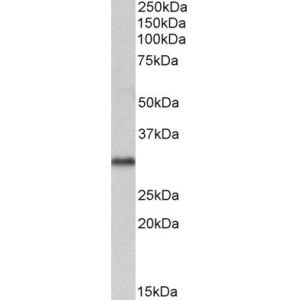 VDAC2 Antibody - C-terminal region (OAEB02034)Catalog #: OAEB02034Application: ELISA|IHC|WBFormat: Supplied at 0.5 mg/ml in Tris saline, 0.02% sodium azide, pH7.3 with 0.5% bovine serum albumin.
 -
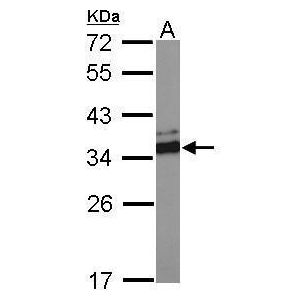 VDAC2 Antibody - C-terminal region (OAGA02386)Catalog #: OAGA02386Conjugation: UnconjugatedApplication: ELISA|ICC|IF|IHC-P|IP|WBFormat: Liquid
 -
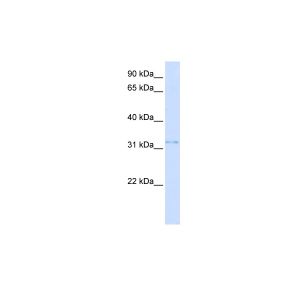 VDAC2 Antibody - N-terminal region (ARP35124_P050)Catalog #: ARP35124_P050Species Tested: HumanApplication: WB, IHCFormat: Liquid. Purified antibody supplied in 1x PBS buffer with 0.09% (w/v) sodium azide and 2% sucrose.